
Should your AI send that quotation, or should a person check it first? AI can now process requests, update records and act across your tools, so the real question for SMEs is where it should act alone and where a person must stay in charge. Singapore’s updated Model AI Governance Framework for Agentic AI gives businesses a practical starting point.
Key Takeaways
- AI autonomy should match business risk.
- Low-risk, easy-to-review tasks suit automation.
- Customer, pricing and financial actions need approval controls.
- Clear digital structures make AI more effective.
- Successful adoption depends on workflow design, not only technology.
What is agentic AI, and why does it matter now?
Agentic AI refers to systems that take actions based on goals and connected business processes. Instead of only generating text, they may interact with your CRM, email or internal databases.
That is why access and approval rules matter. The framework recommends limiting what agents can reach and defining checkpoints where a person must approve, such as before payments or deletions.
How should businesses decide what AI can control?
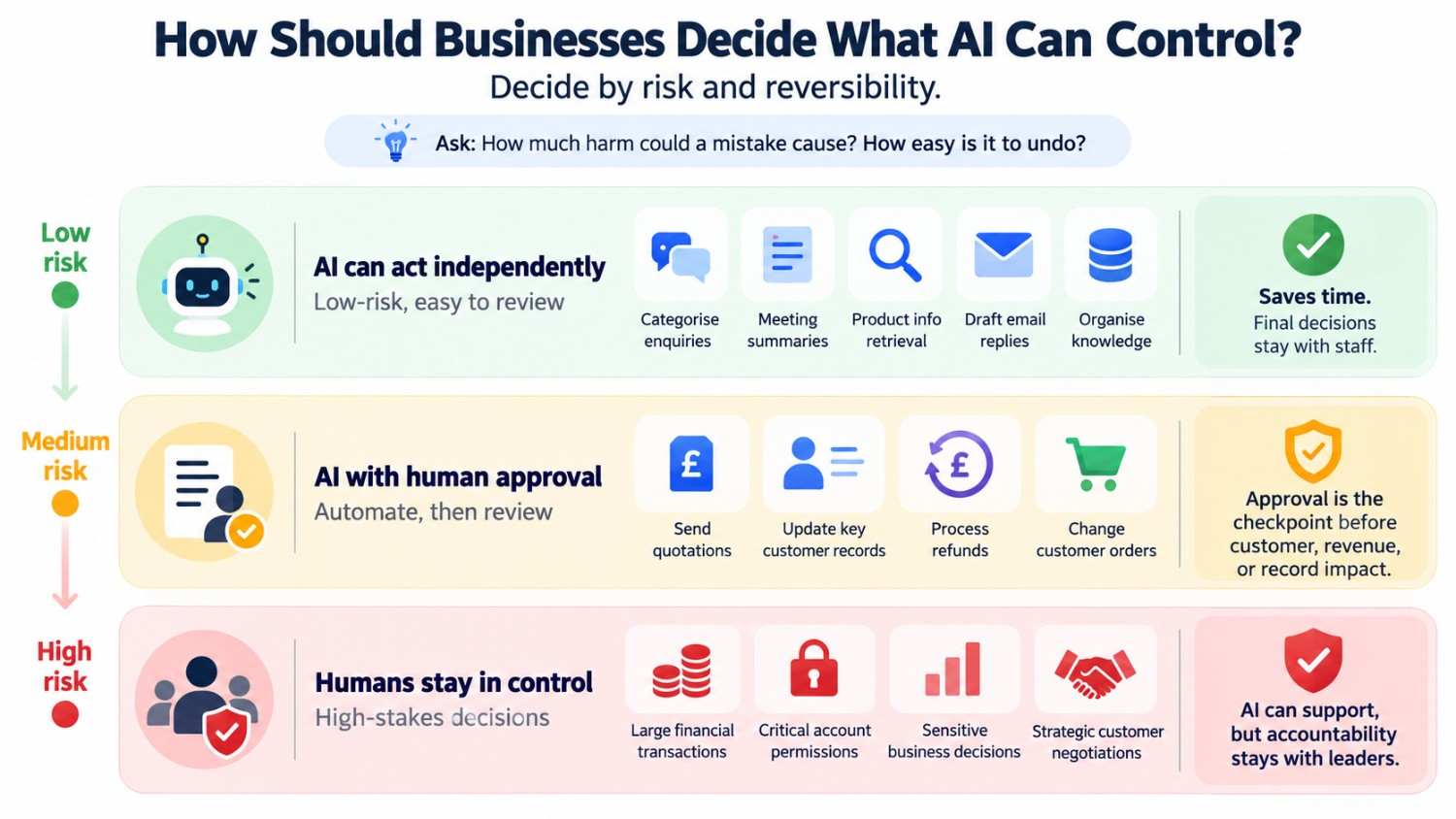
Classify each action by risk and reversibility: how much harm a mistake could do, and how easily you can undo it.
AI can act independently
Low-risk tasks that are easy to review:
- Categorising customer enquiries
- Preparing meeting summaries
- Retrieving product information
- Drafting email responses
- Organising internal knowledge
Teams save time while final decisions stay with employees.
AI with human approval
Actions that can be automated but need a review step:
- Sending quotations
- Updating important customer records
- Processing refunds
- Changing customer orders
Approval is a checkpoint before an action affects customers, revenue or records.
Humans stay in control
Decisions that need direct human responsibility:
- Large financial transactions
- Critical account permissions
- Sensitive business decisions
- Strategic customer negotiations
AI can support the decision, but accountability stays with your leaders.
What mistakes do businesses make?
- Giving AI too much access too early
- Automating unclear processes
- Failing to define approval points
- Ignoring the customer experience
If AI talks to customers, say so clearly. IMDA’s voluntary transparency guidelines for GenAI chatbots recommend a chatbot info card covering capabilities, limits and how to report problems. Our guide to the AI chatbot “nutrition label” shows where to place it.
How does website and digital experience design support AI adoption?
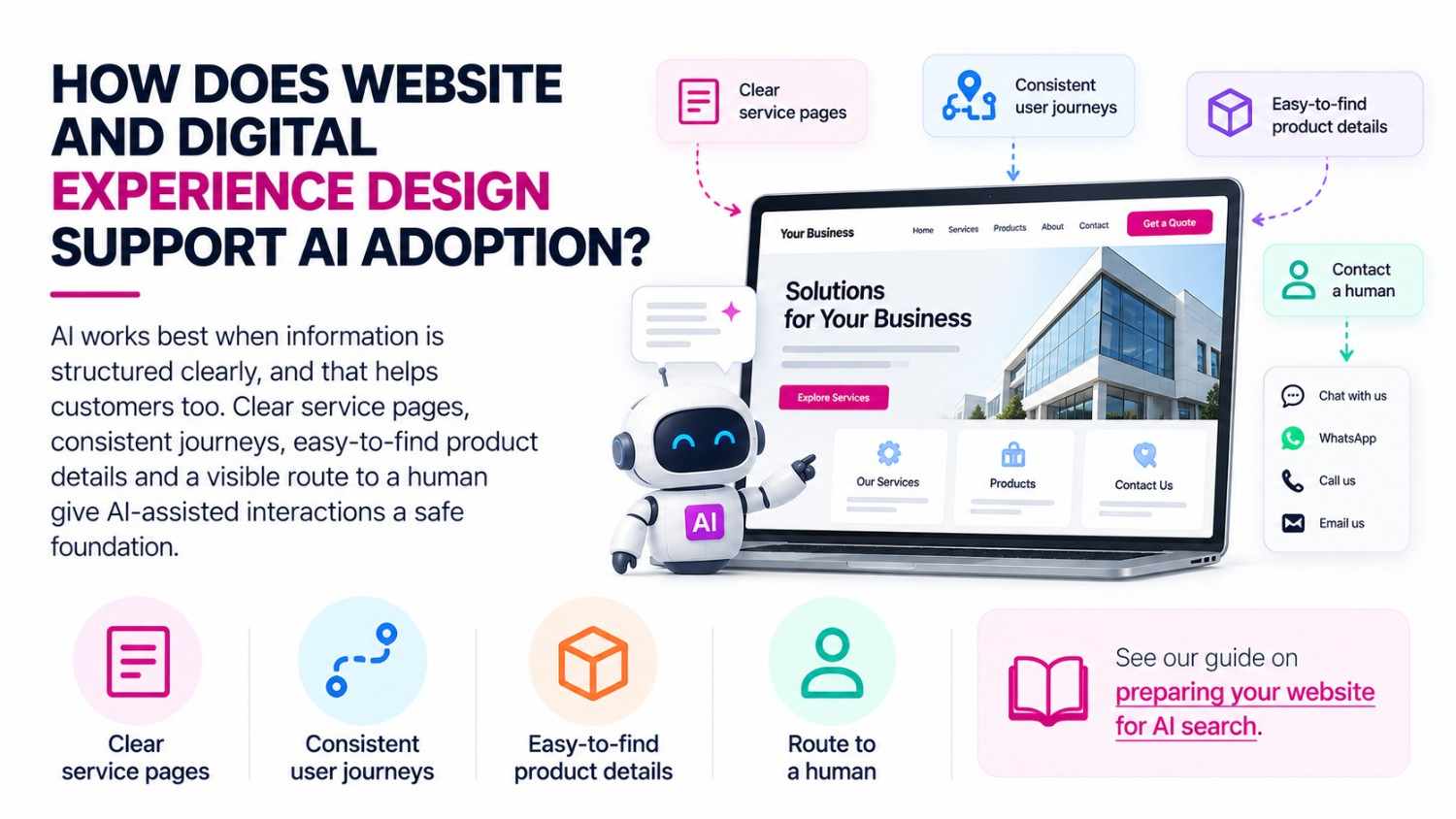
AI works best when information is structured clearly, and that helps customers too. Clear service pages, consistent journeys, easy-to-find product details and a visible route to a human give AI-assisted interactions a safe foundation. See how to prepare your website for AI search.
Getting started
- Identify repetitive workflows suited to automation.
- Decide which actions need approval.
- Connect AI only to the systems it needs.
- Monitor results and improve gradually.
Controlled automation is the goal, not unlimited AI independence.
How eFusion Technology Can Help You Prepare
eFusion Technology has spent over 20 years building the websites and digital systems that business workflows run on, which is where AI approval points need to live.
Our services cover:
- CTO-as-a-Service to decide which tasks AI handles, which need approval and which tools fit your systems
- DPO-as-a-Service to set access limits and PDPA-aligned notifications before AI touches customer data (see our DPO guide)
- Custom web apps and integrations that build approval steps directly into your workflows
- Website design and UI/UX that makes AI disclosures and “talk to a person” options easy to find
- SEO, AEO and GEO strategy so your content is clear to both customers and AI assistants
The focus isn’t adding AI tools. It’s creating a system where technology, process and customer experience work together.
Conclusion: Should AI do this without a human involved?
AI can speed up responses and remove repetitive work, but the best results come from clear boundaries. For every task, ask not only “Can AI do this?” but “Should it, without a person checking?”
Not sure where your approval points belong? Speak to eFusion Technology about scoping safe, controlled automation.
FAQ
What is agentic AI in business?
AI systems that can take actions, complete tasks and use business tools based on defined goals.
Should SMEs let AI send customer emails automatically?
For low-risk messages such as order-status updates, often yes. Route anything involving pricing, commitments or sensitive information through approval.
Can AI update my CRM automatically?
For routine fields, yes. Important customer records should have a review step.
What decisions should AI not make alone?
Large payments, sensitive data, access permissions and major customer commitments.
How can businesses start using AI safely?
Begin with repetitive processes, define approval points, limit system access and improve gradually.