
Is your team still copying enquiries into spreadsheets when AI could handle the first pass? Only 14.5% of Singapore SMEs had adopted AI in 2024, according to IMDA’s National AI Impact Programme factsheet, and the government now aims to support 10,000 enterprises over three years. The step beyond chatbots and content tools is AI agents: they act on a request, update your systems and ask a person to approve before anything goes out. The real question is no longer “Should we use AI?” but “Which process should AI handle first?”
Key Takeaways
- AI agents complete business tasks, not just answer questions.
- Start with repetitive workflows that follow clear rules.
- Document your process before you automate it.
- Keep human approval on important decisions.
- A well-structured website gives agents better information to work with.
What are AI agents, and how are they different from chatbots?
An AI agent is software that understands a goal, plans the steps and acts across your connected tools. A chatbot answers a question. An agent takes a request, finds the right information, completes the task and asks for approval when needed.
Because agents act, governance matters. IMDA’s updated Model AI Governance Framework for Agentic AI stresses human oversight, and the PDPC’s AI guidelines are a useful reference whenever customer personal data is involved. If your agent speaks to customers directly, our guide to AI chatbot transparency in Singapore covers what to disclose.
Which 7 business tasks can SMEs automate with AI agents?
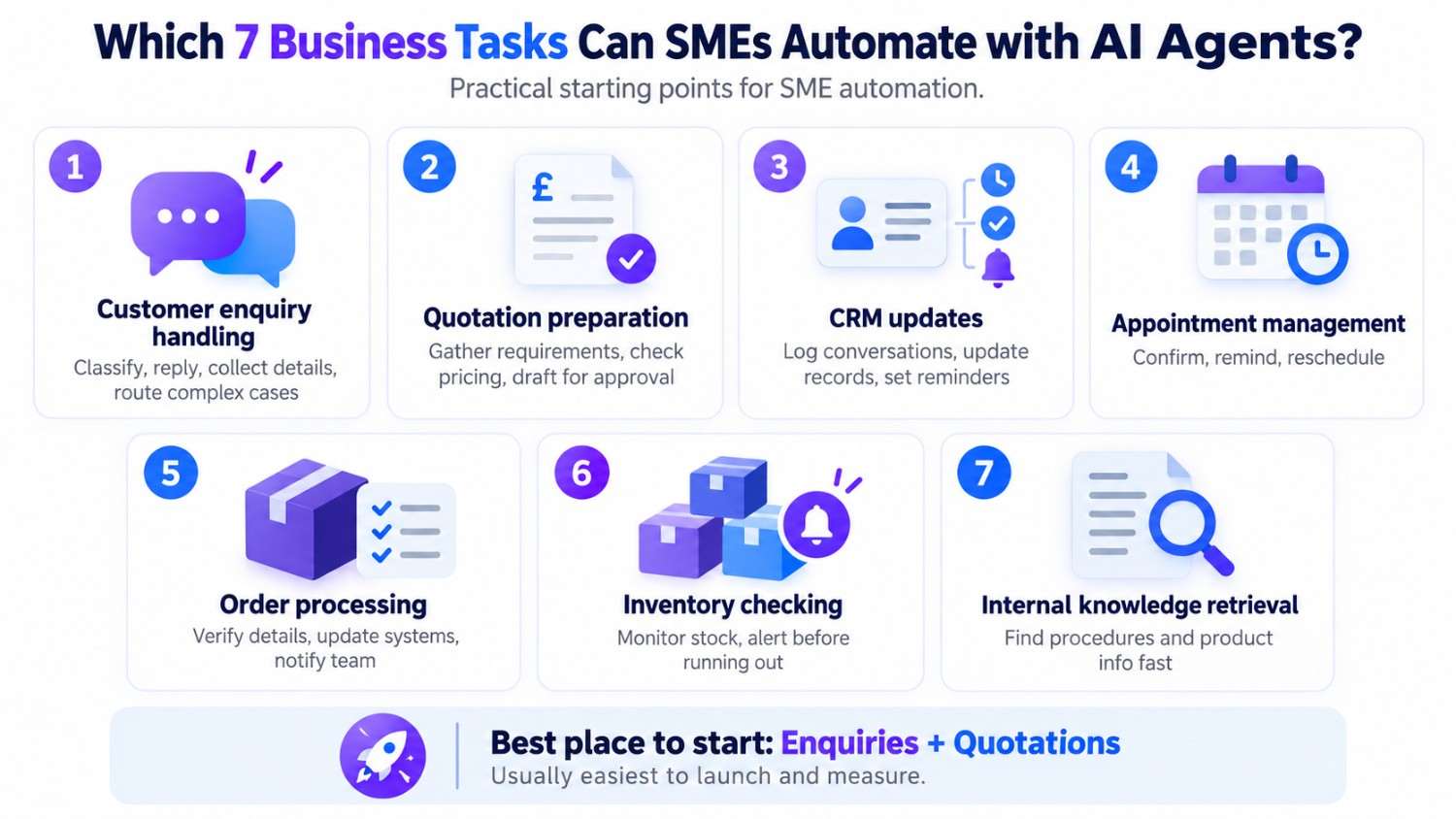
- Customer enquiry handling: classify enquiries, reply instantly, collect details and route complex cases to the right person.
- Quotation preparation: gather requirements, check your pricing and draft a quote for approval.
- CRM updates: log conversations, update records and set follow-up reminders.
- Appointment management: send confirmations and reminders, and handle reschedules.
- Order processing: verify order details, update internal systems and notify the right team.
- Inventory checking: monitor stock levels and alert your team before you run out.
- Internal knowledge retrieval: let staff find procedures and product information in seconds.
Enquiries and quotations are usually the easiest place to start, because the rules are clear and the results are easy to measure.
Is your business ready for AI agents?
AI agents suit SMEs that get frequent enquiries, run repetitive admin, juggle disconnected systems or need faster response times. Hold off if your processes are unclear, your digital records are unreliable, your workflows change without documentation, or you expect AI to make business decisions for you.
What mistakes should SMEs avoid?
- Automating an inefficient process instead of fixing it first
- Giving AI access to sensitive data without controls
- Removing human approval from important decisions
- Choosing tools that don’t fit your existing systems
How does your website affect AI agent success?
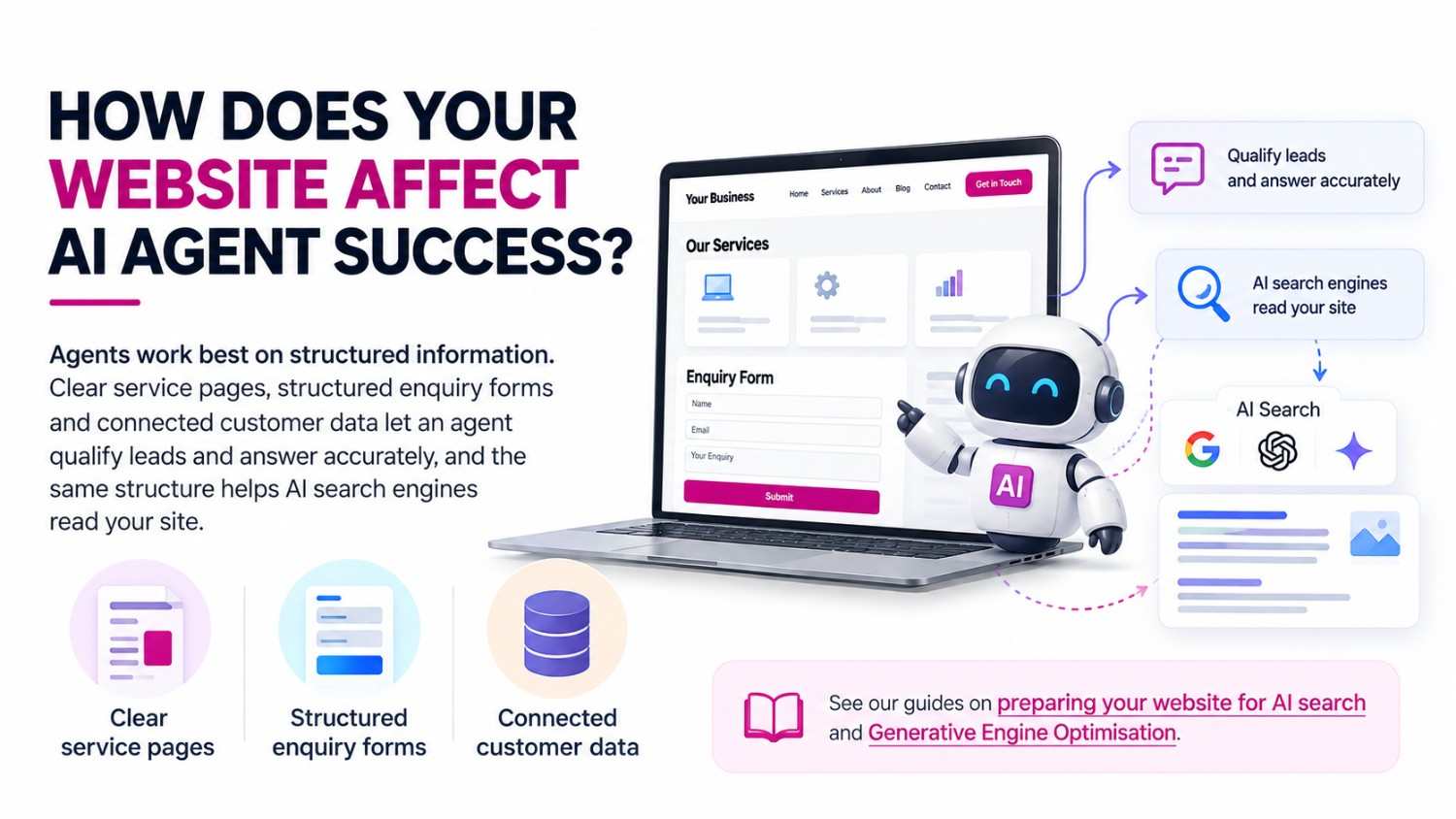
Agents work best on structured information. Clear service pages, structured enquiry forms and connected customer data let an agent qualify leads and answer accurately, and the same structure helps AI search engines read your site. See our guides on preparing your website for AI search and Generative Engine Optimisation.
Getting started
- Identify repetitive tasks with clear rules.
- Document the current workflow.
- Pick one high-impact process to test.
- Connect AI to your existing systems.
- Add human approval points.
- Measure results before expanding.
How eFusion Technology Can Help You Prepare
eFusion Technology has spent over 20 years helping Singapore businesses plan, scope and build websites, e-commerce stores and digital systems, the foundation AI agents depend on. Our services cover:
- CTO-as-a-Service to choose the right first process, document the workflow and pick tools that fit your existing systems
- Custom web apps and integrations that connect your enquiry forms, CRM, orders and inventory so agents work from clean data
- DPO-as-a-Service to set data access controls and PDPA-aligned notifications before an agent touches customer information
- Omnichannel e-commerce and marketplace management to keep orders and stock in sync across your channels
- SEO, AEO and GEO strategy so your services are easy for search engines and AI assistants to find and cite
The goal isn’t to add an AI tool for its own sake. It’s to build the digital foundation that makes automation work.
Conclusion: What should Singapore SMEs do next?
Pick one repetitive, measurable workflow, keep a person in the approval loop and prove the result before you expand. AI agents deliver the most value when they solve a practical problem, not when they follow a trend.
Not sure which process to automate first? Speak to eFusion Technology about scoping your first automation project.
FAQ
What is an AI agent for business use?
A system that understands an objective, performs multiple steps and completes tasks using your connected business tools.
Are AI agents suitable for small businesses?
Yes. SMEs can use them for customer service, admin, sales support and internal operations, as long as processes are clearly defined.
How are AI agents different from ChatGPT?
ChatGPT mainly responds with text. An AI agent can also act, such as updating a CRM, creating a task or triggering a workflow.
Do SMEs need a custom application for AI automation?
Not always. Some can start with existing tools, while others need a custom web application to connect specific workflows.
How should SMEs prepare for AI adoption?
Organise your data, document your processes, pick one automation opportunity and set clear human review points.