

Is your website ready for the AI-driven shift in how customers find answers? Many companies still design websites only for human visitors and traditional search rankings. That is no longer enough. Buyers now ask AI tools and AI-powered search results for direct recommendations, comparisons, and summaries before they visit a website.
Key takeaways
- GEO helps AI-powered search tools understand and reference your website.
- Strong SEO foundations still matter for AI search visibility.
- Clear website structure improves both user experience and AI readability.
- GEO works best when content, UI/UX, and lead generation strategy align.
What is Generative Engine Optimization?
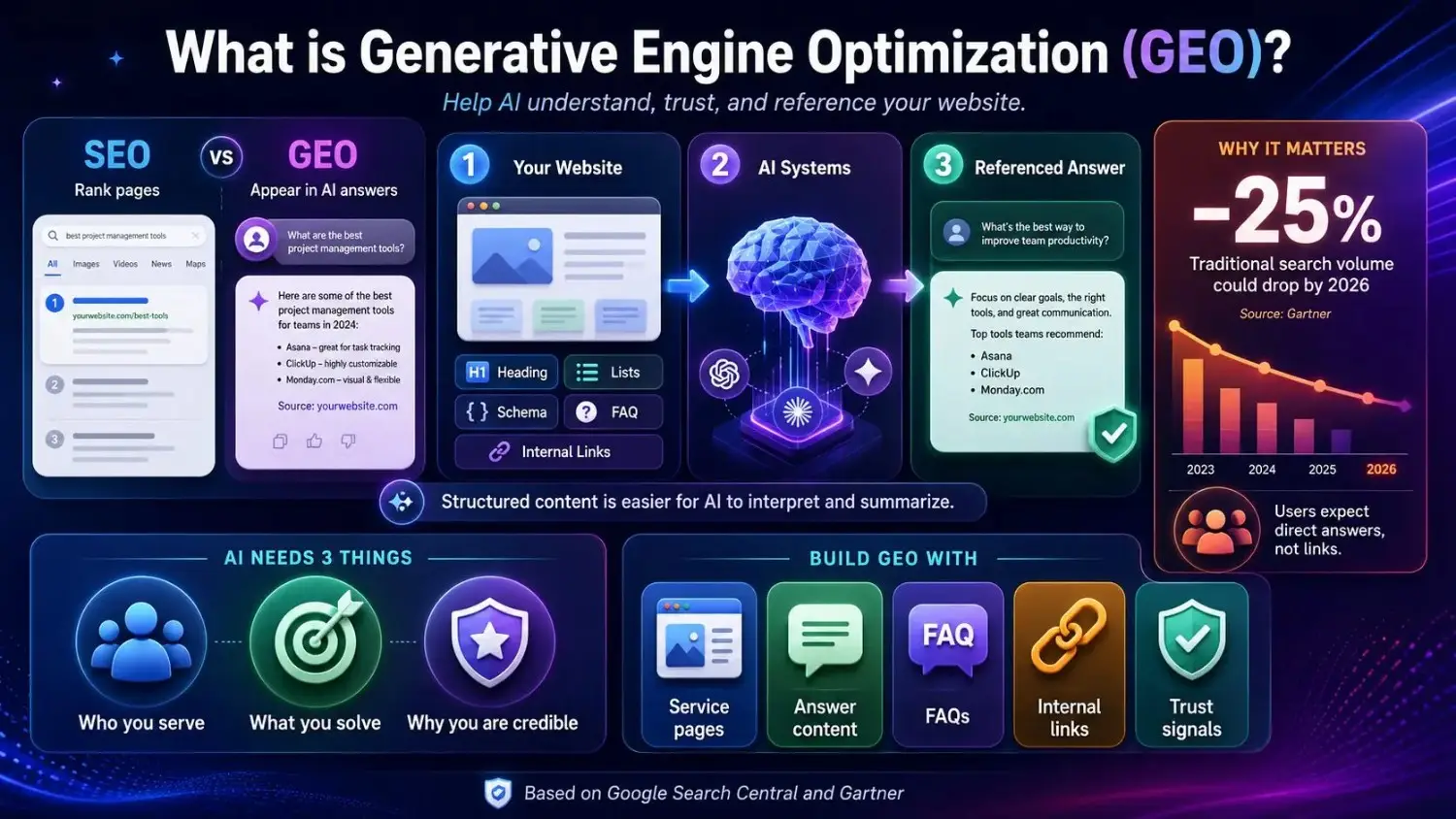
Generative Engine Optimization (GEO) ensures your website is structured in a way that AI systems can easily understand, summarize, and reference. While GEO builds on traditional SEO practices, it goes further: it focuses on being included in AI-generated answers rather than simply ranking pages.
The optimization for generative AI search still relies on strong SEO foundations, as AI-driven results are tied to core search ranking and quality systems. While GEO focuses on being included in AI-generated answers, it is still built upon traditional SEO fundamentals. Without solid SEO, GEO cannot help AI find or reference your website.
GEO involves structuring content so that AI-powered search engines and answer platforms can accurately interpret, extract, and present your information. This is increasingly important as users expect direct answers without navigating multiple pages. It is predicted that traditional search engine volume could drop by 25% by 2026 as more users rely on AI chatbots and virtual assistants.
How does GEO work in simple terms?
GEO helps AI systems understand three things:
- Who your business serves
- What problem your solution solves
- Why your content is credible enough to reference
This means your website needs clear service pages, answer-based content, structured FAQs, strong internal links, and content that directly responds to real customer questions.
Is your business ready for GEO?
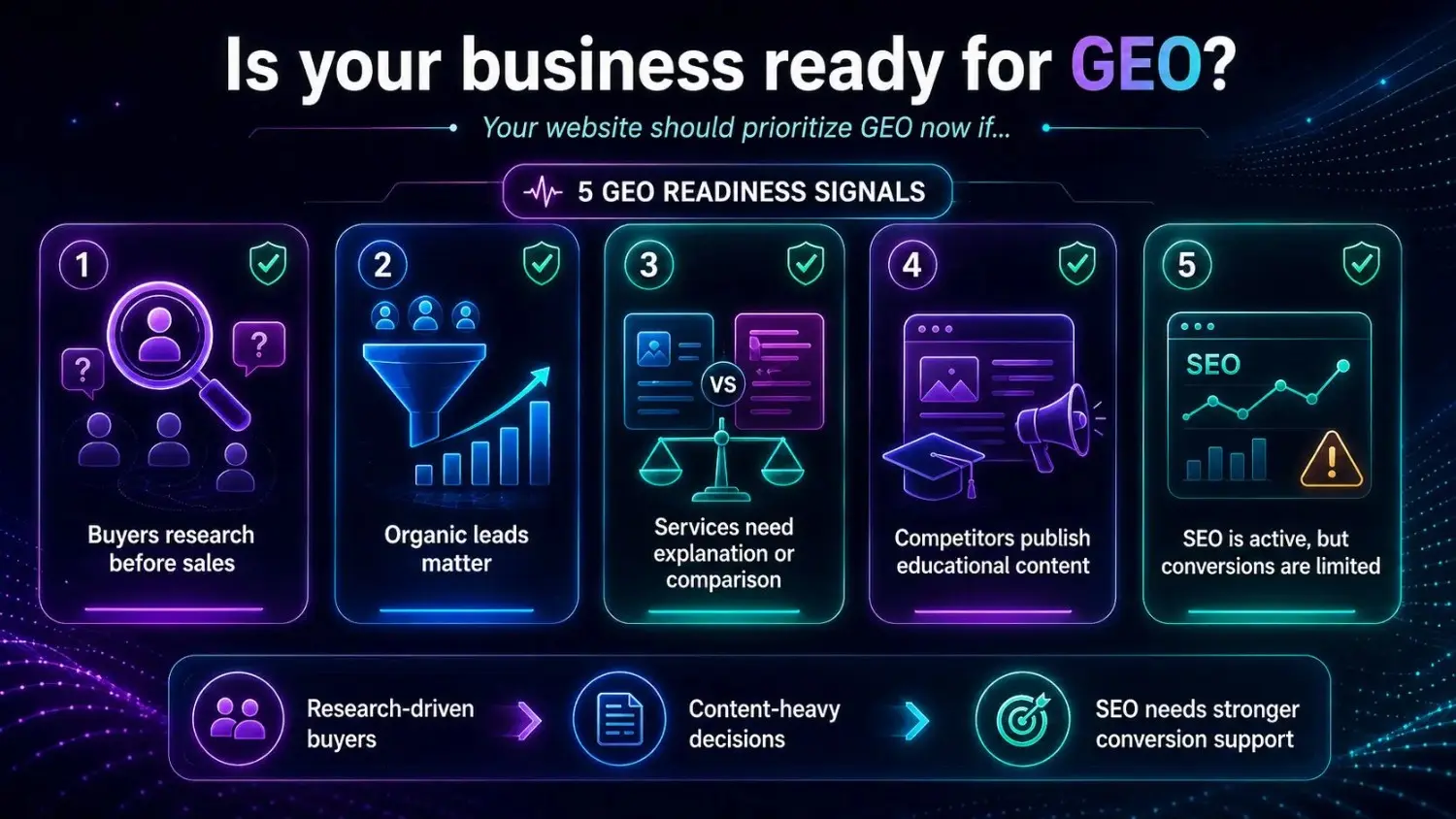
Your website should prioritize GEO now if:
- Your buyers research solutions before contacting sales
- Your website depends on organic leads
- Your services require explanation or comparison
- Your competitors are publishing educational content
- Your website already has SEO activity but limited conversions
Why does GEO need strong website design?
A website built for GEO must be easy to understand for both users and AI systems. Clear navigation, logical page hierarchy, readable content blocks, and conversion-focused UI/UX all support better discovery and decision-making.
For example, a service page should not only look professional. It should explain the problem, define the solution, show who it is for, answer common objections, and guide visitors toward enquiry.
This is where seamless UI/UX design, clear information structure, and lead generation strategy work together.
How can businesses implement GEO practically?
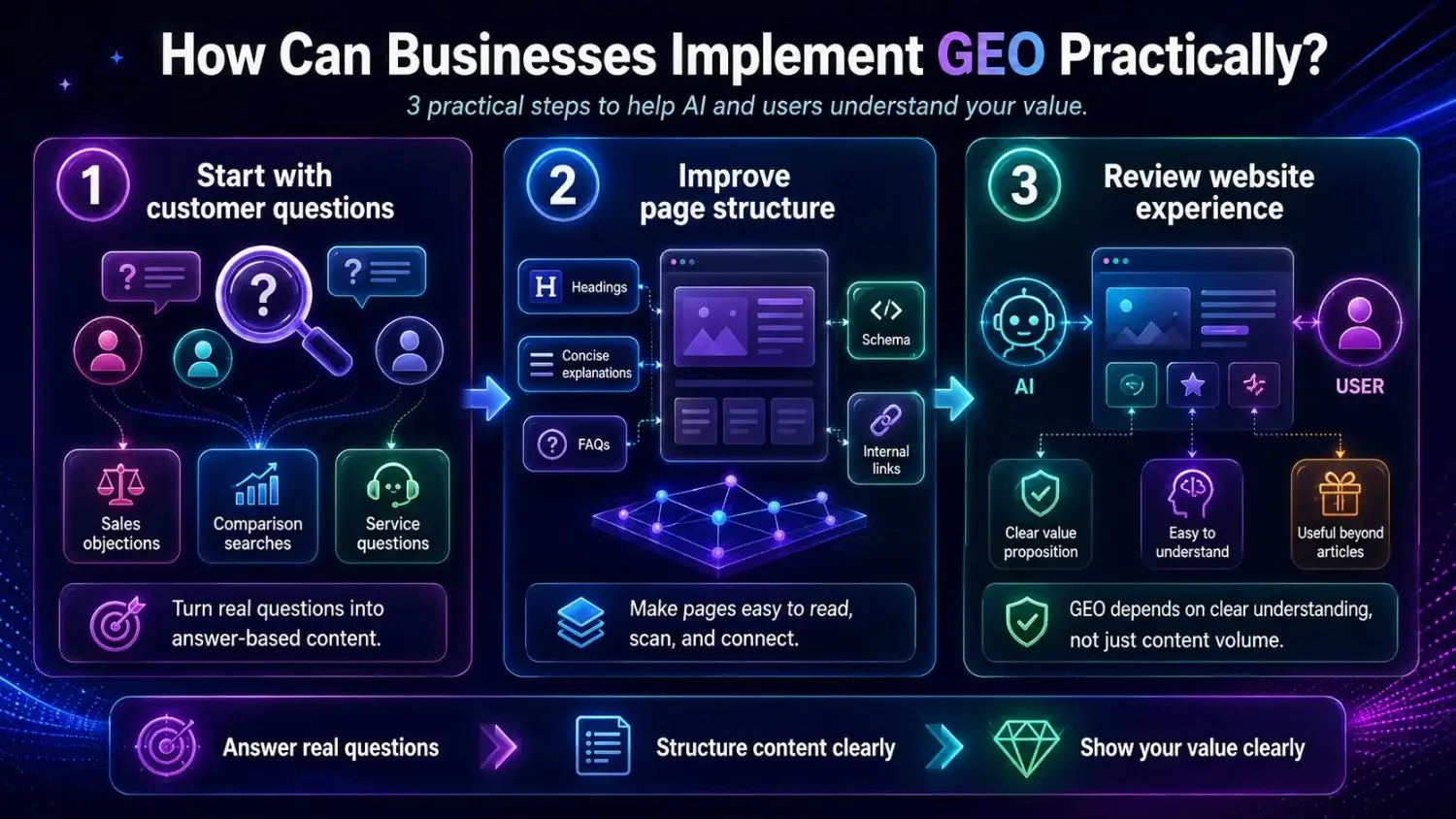
Start with customer questions. Turn sales objections, comparison searches, and service-related queries into answer-based content.
Next, improve page structure. Use direct headings, concise explanations, FAQs, schema where relevant, and internal links between related services.
Finally, review your website experience. GEO is not only about articles. It also depends on whether users and AI systems can clearly understand your value proposition.
How eFusion Technology can help
eFusion Technology helps businesses build websites that are clear, searchable, and conversion-ready.
By combining strategic design and performance optimization, eFusion helps businesses unlock the hidden layer of growth:
- Web Design and Development Build conversion-focused websites with clear structure and fast performance
- UI/UX Optimization Improve user journeys to reduce friction and increase engagement
- E-commerce Solutions Develop scalable platforms tailored to business goals
- AIGC Content Strategy Create structured, intent-driven content optimized for AI and search engines
- SEO, AEO, and GEO Strategy Align content with modern search behavior to improve visibility and conversions
The focus is practical: better structure, clearer content, smoother user experience, and stronger website performance.
What should businesses do next?
GEO is not replacing SEO. It is expanding how businesses need to think about online visibility. A website that answers real questions clearly has a better chance of being discovered, trusted, and selected.
For businesses planning a website redesign or content strategy update, GEO should be part of the discussion from the beginning. Connect with eFusion Technology to explore how your website can be optimized for clarity, conversion, and scalable growth.
FAQ
What is GEO in digital marketing?
GEO means Generative Engine Optimization. It helps website content appear in AI-generated answers.
Is GEO the same as SEO?
No. SEO focuses on search rankings. GEO focuses on visibility in AI-generated responses, while still relying on SEO foundations.
Why does my website need GEO?
Your website needs GEO because buyers increasingly use AI search tools to compare solutions and make decisions faster.
Can GEO improve lead generation?
Yes. GEO can support lead generation when your content answers buyer questions clearly and guides users toward action.
What type of content works best for GEO?
Answer-based articles, FAQs, comparison pages, service explanations, and structured educational content work well.