

Do Singapore Businesses Need an AI Chatbot “Nutrition Label” in 2026? Could an unclear chatbot quietly cost you customers? A GenAI chatbot can answer instantly, but if visitors cannot tell how reliable it is, how their data is used, or where to flag a problem, that speed can undermine trust rather than build it. Singapore now has a practical framework for closing that gap, and it lands at a moment when AI transparency is becoming as important to search visibility as it is to compliance.
Key Takeaways
- IMDA’s chatbot information-card guidelines, released 20 July 2026, are voluntary.
- PDPA obligations, including new AI-specific notifications, may still apply to personal data.
- Disclosures should be clear, accessible, plain-language and kept current.
- Where the card sits on your website affects both user trust and how AI search engines read your page.
What is an AI chatbot information card?
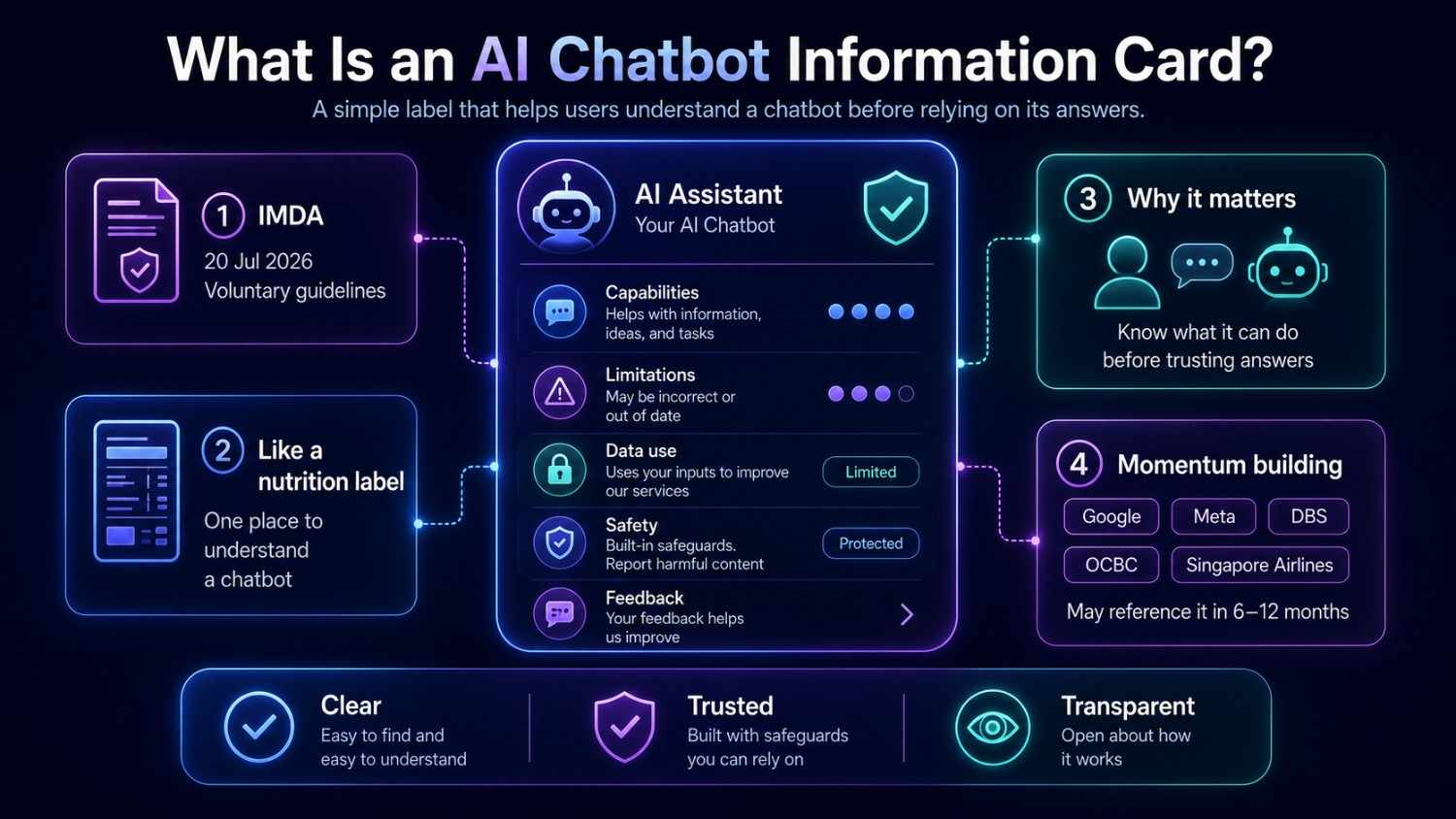
On 20 July 2026, the Infocomm Media Development Authority introduced voluntary Transparency Guidelines for GenAI Chatbots, among the first frameworks of its kind globally. It centres on a chatbot information card, comparable to a nutrition or medicine label, giving users one place to understand a chatbot before relying on its answers. Google, Meta, DBS, OCBC and Singapore Airlines have signalled plans to reference it within the next six to twelve months.
Are the guidelines mandatory?
No, adoption is voluntary. But businesses should still consider it wherever a chatbot interacts directly with customers, shares important information or handles personal data. Existing PDPA duties may still apply: PDPC guidance now requires AI-specific notifications explaining the purpose, data involved and how users can decline or withdraw consent when personal data is repurposed for GenAI.
What should the card disclose?
IMDA recommends covering the chatbot’s capabilities and limitations, its safety and reliability measures, how data is collected and protected, and how users can give feedback or report concerns. Content should be relevant, easy to find, written in plain language, and reviewed whenever capabilities or safety policies change.
Where placement meets SEO
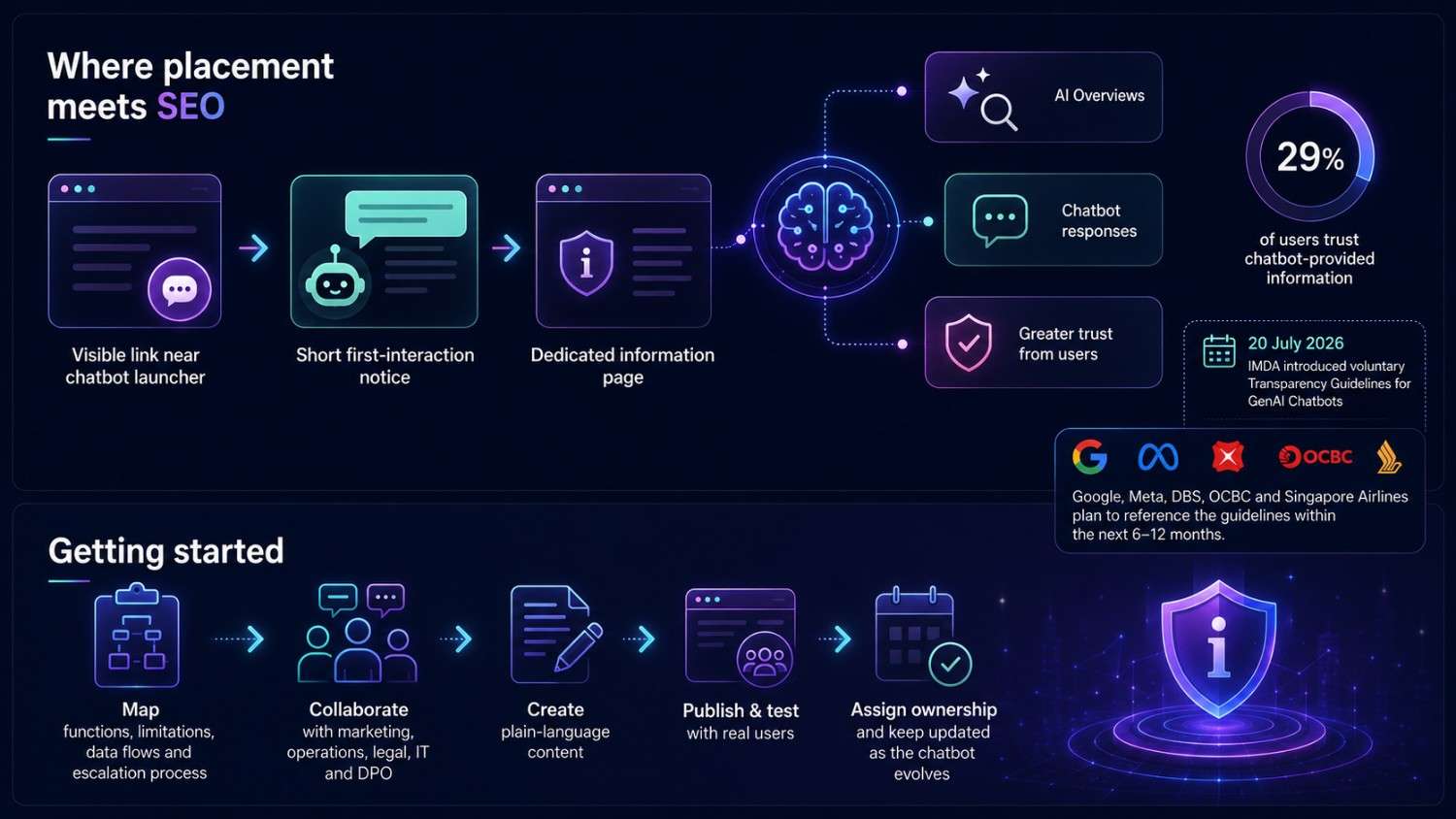
Trust and search visibility are converging faster than most businesses expect. A visible link near the chatbot launcher, a short first-interaction notice, and a dedicated information page all support the customer journey without interrupting it. That same well-structured, plain-language content is exactly what large language models draw on when generating answers, so a clear disclosure page can double as citable material for AI Overviews and chatbot responses. Given that only 29% of users say they trust chatbot-provided information, transparent, well-placed disclosures are becoming a genuine differentiator, not just a compliance checkbox. This is also why we’ve been tracking Generative Engine Optimisation and preparing websites for AI search as priority topics this quarter.
Getting started
Map the chatbot’s functions, limitations, data flows and escalation process. Turn the findings into plain-language content with input from marketing, operations, legal, IT and your Data Protection Officer. Publish it, test it with real users, and assign ownership for updates whenever the chatbot changes.
How eFusion Technology Helps You Prepare
eFusion Technology has spent over 20 years helping Singapore brands build e-commerce ecosystems connecting owned websites, marketplaces, social commerce, and payment flows — and in 2026, that scope now includes AI search visibility and AI transparency readiness.
Our services cover:
- DPO-as-a-Service to map data flows, draft PDPA-aligned AI-specific notifications, and keep your chatbot’s information card current
- Custom web development and chatbot integration, plus Shopify and SHOPLINE implementation for complex commerce needs
- UI/UX design focused on conversion, placing disclosures where they build trust rather than create friction
- Comprehensive SEO packages — keyword research, technical SEO, content, and local SEO — backed by our Performance Improvement Guarantee
- AEO and GEO strategy, plus AIGC content production, to get your brand cited by ChatGPT, Perplexity, and Google AI Overviews, not just ranked on page one
- Broader growth support through our MEG multi-agency network and our founding membership in the Singapore AI Association (SAIA)
The goal isn’t just publishing a disclosure — it’s building a chatbot experience customers trust, and a page structured well enough that AI engines trust it too.
Conclusion: What Should Singapore Businesses Do Next?
Voluntary doesn’t mean optional in practice. Start by mapping what your chatbot can and can’t do, tighten how disclosures are worded and placed, and treat that page as content AI engines can cite, not just a compliance footnote. Businesses that pair clear, accessible disclosures with an AI-ready site structure will be the ones customers, and AI answers, trust.
Need to know if your chatbot and website are ready for both PDPA and AI search? Speak to eFusion Technology for an AI visibility and compliance-readiness review.
FAQ
Is AI chatbot disclosure mandatory in Singapore?
The IMDA information card is voluntary as of July 2026, though other legal and sector-specific duties may apply.
What is an AI chatbot nutrition label?
A plain-language information card explaining a chatbot’s functions, limitations, safety practices, data handling and feedback channels.
Does the PDPA apply to AI chatbots?
Yes, whenever an organisation collects, uses or discloses personal data through the chatbot.
Where should the information card appear?
Near the chatbot launcher, with a link to a dedicated, accessible information page.
How often should the card be updated?
After any significant change to the chatbot’s capabilities, risks, model, data use or safety policies.