

Every SME that decides to build a proper website or e-commerce store hits the same question early: how do we pay for this? It’s a question that more businesses are asking — Singapore’s digital economy grew to S$128.1 billion in 2024, and 95.1% of SMEs have now adopted at least one digital area of their business (The Edge Singapore, 2025). Government grants get most of the attention, but they’re only one piece of how Singapore businesses actually fund digital projects. The businesses that plan well usually combine a few approaches — and know which parts of a project to build first.
Key Takeaways
- Most SMEs fund digital projects through a mix of self-funding, financing, and partial grant co-funding — rarely just one.
- Government co-funding schemes (like PSG and EDG) typically cover a portion of eligible costs, not the full project — budgeting for the remainder matters just as much.
- Financing options like the Enterprise Financing Scheme and standard SME working capital loans exist for projects too large to self-fund upfront.
- Scoping a project in phases — building the essentials first — reduces how much funding you need to secure before starting.
- Whichever funding route you use, the project still needs to be scoped, built, and maintained properly to deliver a return.
How Singapore SMEs Actually Fund a Website, E-Commerce, or Digital Project
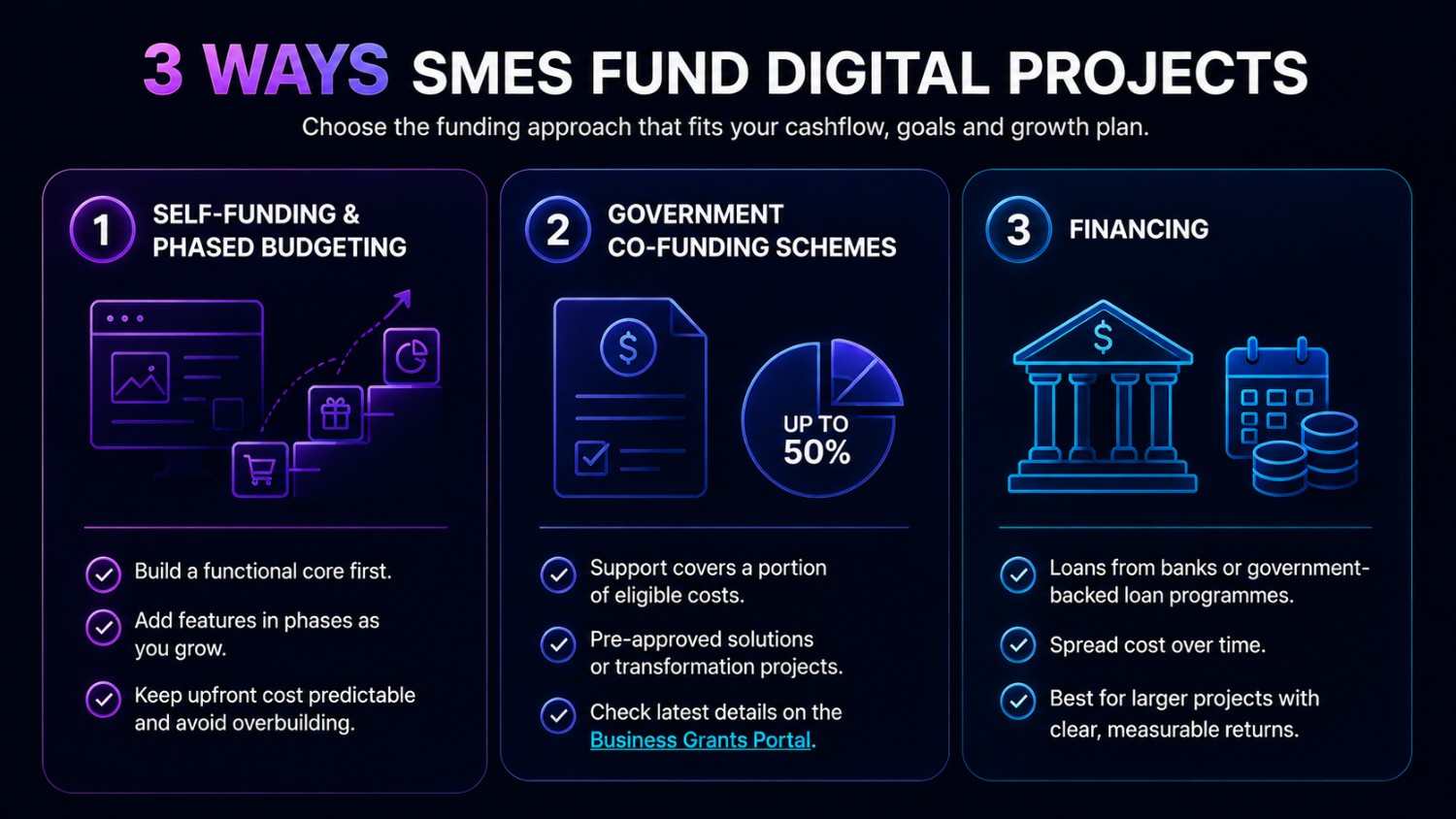
Option 1: Self-Funding and Phased Budgeting
The simplest way SMEs fund a website or e-commerce build is out of operating budget, often spread across phases rather than paid as one lump sum. Instead of committing to every feature on day one, businesses build a functional core — a working website or online store — and add features like loyalty programs, advanced automation, or marketplace integrations once the first phase is generating results. This approach keeps upfront cost predictable and avoids overbuilding features the business hasn’t validated it needs yet.
Option 2: Government Co-Funding Schemes
Singapore has long offered co-funding support for SMEs adopting digital tools, through schemes administered by Enterprise Singapore and IMDA. These generally work by covering a portion of eligible project costs — commonly up to half — for pre-approved IT solutions or larger transformation projects, rather than funding a project in full. Because eligibility criteria, supported categories, and funding levels are reviewed and updated periodically, the most reliable approach is to check current details directly through the Business Grants Portal before scoping a project around a specific scheme.
Co-funding is worth exploring for projects that fit a supported category, but it shouldn’t be the only funding assumption in your budget — approval isn’t guaranteed, and support only covers part of the cost.
Option 3: Financing
For larger digital transformation projects — full ERP implementations, omnichannel builds, custom platforms — some SMEs use financing rather than paying entirely upfront. Options include standard SME working capital loans from participating banks such as DBS, OCBC, and UOB, as well as government-backed loan facilitation programmes that share default risk with lenders to make credit more accessible to smaller businesses (Sleek, Singapore Business Loans Guide, 2026). Financing spreads cost over time but adds interest and repayment obligations, so it tends to make more sense for projects with a clear, measurable return.
Getting the Scope Right Before You Spend
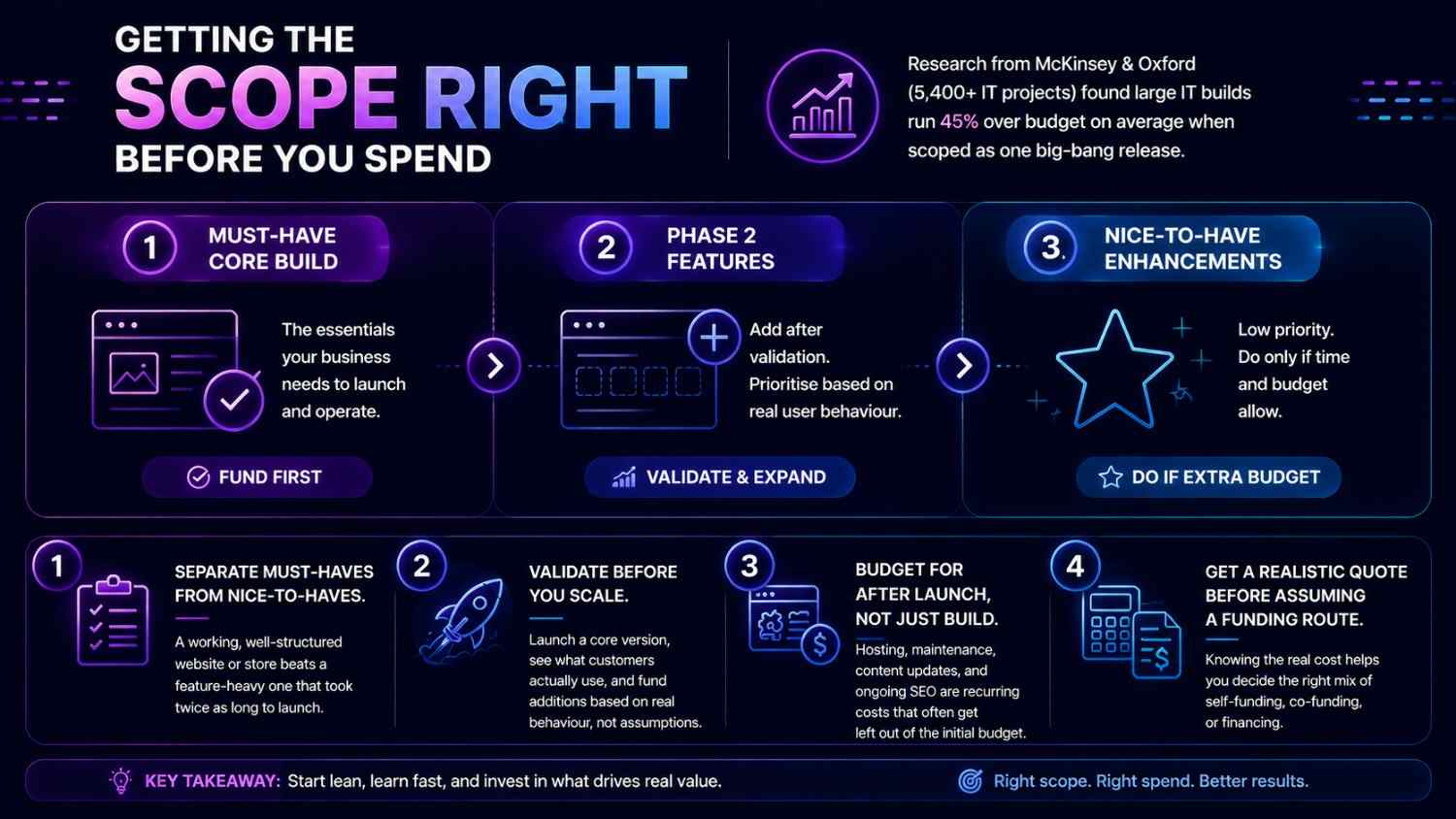
Regardless of how a project is funded, the biggest cost risk is usually scope, not the funding source. Research from McKinsey and the University of Oxford, based on more than 5,400 IT projects, found that large IT builds run 45% over budget on average when scoped as one big-bang release rather than phased — a pattern that holds directionally even at SME scale (McKinsey & Company). A few practical checks before committing budget:
- Separate must-haves from nice-to-haves. A working, well-structured website or store beats a feature-heavy one that took twice as long to launch.
- Validate before you scale. Launch a core version, see what customers actually use, and fund additions based on real behaviour rather than assumptions.
- Budget for after launch, not just build. Hosting, maintenance, content updates, and ongoing SEO work are recurring costs that often get left out of the initial budget.
- Get a realistic quote before assuming a funding route. Knowing the real cost of the project you want makes it much easier to work out which combination of self-funding, co-funding, or financing actually covers it.
Note for Business Owners: Grant Schemes Are Being Reorganised in 2026
Worth knowing if you’re budgeting around a specific scheme: under Budget 2026, Enterprise Singapore announced that the Market Readiness Assistance (MRA), Productivity Solutions Grant (PSG), and Enterprise Development Grant (EDG) will be streamlined into a single scheme called EDGE, intended to make support easier to access across different types of business activity. The change is set to open eligibility to all Singapore businesses, including non-SMEs, which are broader than PSG and EDG cover today.
In the meantime, businesses can continue applying for EDG, MRA, and PSG as they currently exist through the Business Grants Portal. Full details on EDGE, including specific support levels, are expected to be published closer to its rollout (Enterprise Singapore, Budget 2026).
How eFusion Technology Can Help
eFusion Technology has spent over 20 years helping Singapore businesses plan, scope, and build websites, e-commerce stores, and digital transformation projects.
Our services include:
- Web and e-commerce development, scoped in phases so businesses can launch a solid core first and expand as the project proves itself
- Digital transformation projects — omnichannel systems, ERP/CRM integration — for businesses planning larger builds
- Realistic project scoping and quoting, so you know the actual cost before deciding how to fund it
- Post-launch support and maintenance, so the ongoing cost of running the project is part of the plan from the start
We work with businesses regardless of how a project is funded — the priority is building something that performs.
Conclusion
Grants can meaningfully reduce the cost of a digital project, but they’re rarely the whole funding plan. Businesses that combine a clear-eyed budget, the right scope, and (where eligible) available co-funding tend to end up with projects that are both affordable and actually finished. Start with what the project needs to do, get a real quote, then work out the funding mix that makes sense.
Talk to eFusion Technology about scoping a digital project and understanding the realistic cost before you commit to a funding route.
FAQ
Do I need a government grant to build a website or e-commerce store?
No. Many SMEs fund these projects through operating budget or financing. Grants can help offset cost for eligible projects, but they aren’t a requirement to get started.
How much of a project’s cost do government grants typically cover?
It varies by scheme and project type, and is subject to change — check the Business Grants Portal for current, project-specific figures rather than relying on older percentages.
What’s the benefit of building a project in phases?
It reduces the amount of funding you need upfront, lets you validate what customers actually use before investing further, and avoids paying for features that don’t end up mattering.
Should I get a quote before or after deciding how to fund a project?
Before. A realistic quote makes it much easier to compare self-funding, financing, and any available co-funding, rather than guessing at cost first.
What ongoing costs should I budget for after launch?
Hosting, maintenance, content updates, and SEO are common recurring costs that are easy to underestimate when budgeting only for the initial build.