

Singapore brands entering the 9.9–11.11 season face a bigger decision than discount depth: where should the sale happen? Shopee, Lazada, TikTok Shop, and a brand-owned e-store serve different customer behaviours; treating them as interchangeable dilutes budget and focus.
Key Takeaways
- Select platforms according to customer behaviour, not popularity alone.
- TikTok Shop now outranks Lazada in Singapore GMV share — don’t underweight it.
- Treat Brand.com as an owned strategic asset.
- Avoid expanding faster than operations can support.
- Measure profitability and retention alongside marketplace GMV.
Which E-Commerce Channel Matters Most for 9.9–11.11?
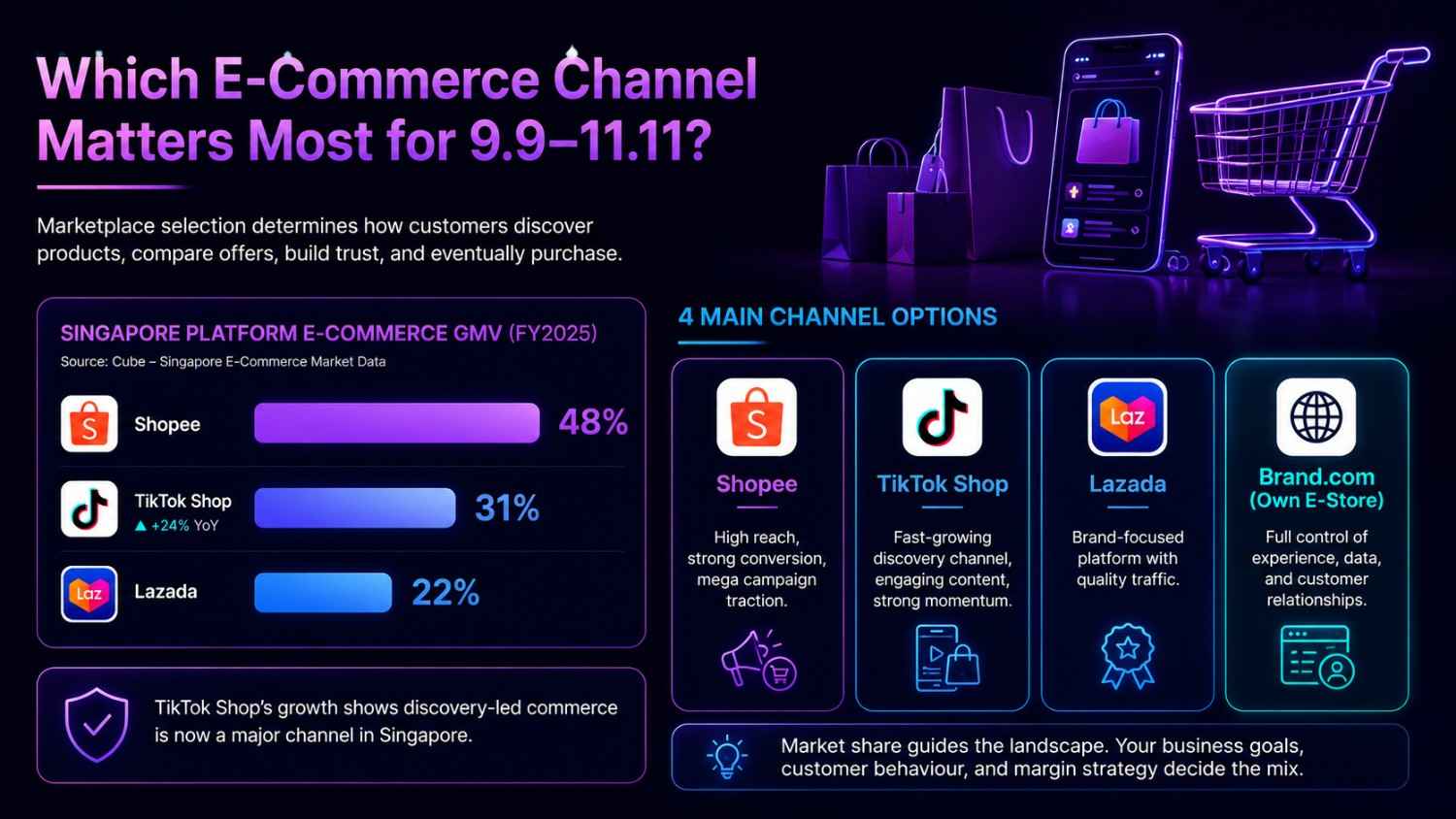
Marketplace selection determines how customers discover products, compare offers, build trust, and eventually purchase.
Singapore data makes the differences clear. Shopee held roughly 48% of Singapore’s platform e-commerce GMV in FY2025, TikTok Shop climbed to 31% (up 24% year-on-year), and Lazada held 22% following its shift toward a brand-led strategy, per Cube’s Singapore e-commerce market data. TikTok Shop’s growth alone shows discovery-led commerce is no longer a side channel here.
Market share alone shouldn’t decide strategy. Brand.com — the company’s own e-store — adds another important option: direct ownership of the customer experience.
Concept Explanation: How Do Shopee, Lazada, TikTok Shop and Brand.com Differ?
Shopee suits brands seeking broad reach and shoppers already showing intent, backed by ads for visibility, campaign optimisation, and vouchers.
Lazada suits established brands prioritising marketplace credibility. LazMall gives eligible brands authenticity positioning, dedicated campaigns, and added visibility.
TikTok Shop matters most when discovery depends on videos, creators, demonstrations, or LIVE content, linking listings directly to content and shop profiles.
Brand.com offers what marketplaces cannot: merchandising control, customer journeys, brand storytelling, first-party relationships, and long-term organic visibility.
Readiness Checklist: Who Should Prioritise Each Channel Now?
Prioritise Shopee for broad demand and marketplace-led conversion; Lazada for established products where brand credibility matters; TikTok Shop for demonstration-friendly products; and Brand.com when retention, ownership, bundles, and brand experience are strategic priorities. Most brands should aim for an integrated model, not one channel.
Not-Ready Checklist: Who Should Not Expand Yet?
Don’t spread across four channels just because 9.9 is near. Limit channels where inventory, product info, fulfilment capacity, or team bandwidth can’t support them.
TikTok Shop also caps new Singapore shops during its adjustment period — as low as 100 orders and 1,000 listings a day until they graduate to higher tiers — a real constraint for last-minute onboarding.
Common Pitfalls: What Should Brands Avoid?
The biggest mistake is copying the same promotion, product page, and customer journey everywhere. Another is acquiring customers on marketplaces without building Brand.com as a long-term destination — marketplace sales drive volume, but an owned store builds retention.
So Why Does Brand.com Still Matter?
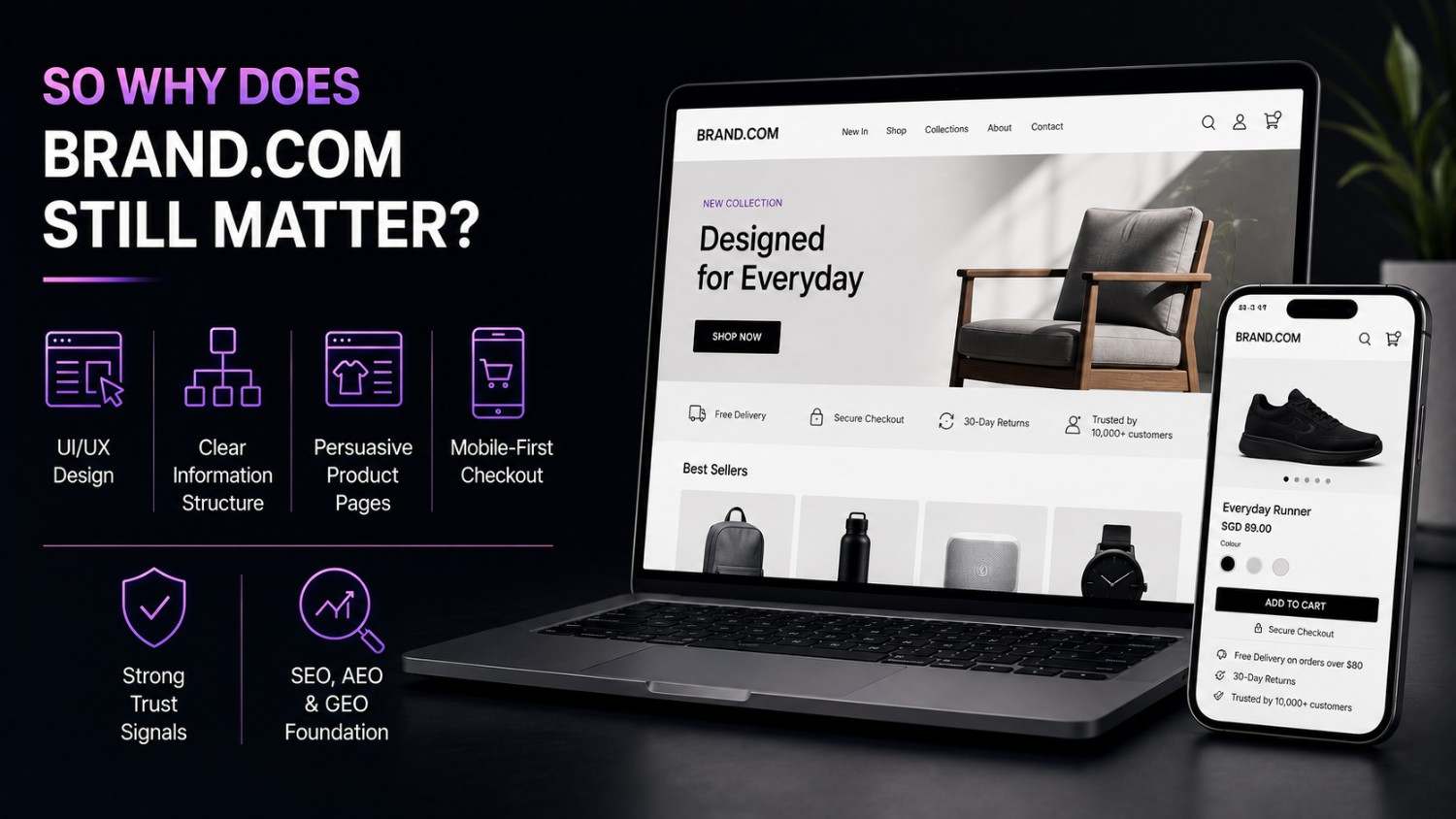
A 9.9 marketplace campaign may drive discovery, but customers increasingly research brands beyond the marketplace before buying — 74% of Singapore consumers now say they’re open to using AI tools to shop more efficiently, making AI-readable brand content a real conversion factor, not just an SEO extra.
A Brand.com e-store should provide seamless UI/UX design, clear information structure, persuasive product pages, mobile-first checkout, and strong trust signals — plus an owned foundation for SEO, AEO, and GEO that keeps the brand discoverable beyond campaign periods.
Implementation Approaches: How Should Brands Build the Channel Mix?
Start with one primary conversion channel, one supporting acquisition channel, and Brand.com as the owned foundation. Measure channels by contribution margin, conversion rate, AOV, repeat purchases, and acquisition efficiency — not GMV alone.
How eFusion Technology Can Help
eFusion Technology has spent over 20 years helping Singapore brands turn a scattered channel presence into one that actually converts.
Our services include:
- E-commerce platform management (Shopee, Lazada, TikTok Shop), so campaigns and vouchers are optimised per platform, not copy-pasted across them
- Web and e-commerce development for your own webstore, so the owned store has UI/UX, checkout, and trust signals marketplaces can’t replicate
- AIGC content production, so product pages, LIVE-ready video, and creator-style content are built for how each channel converts
- SEO, AEO, and GEO strategy, so the brand stays discoverable on Brand.com after the 9.9–11.11 campaign ends
We work with brands regardless of which channels they’re already on — the priority is building a mix that converts.
Conclusion: Which Platform Should Singapore Brands Choose?
There is no universal winner for 9.9–11.11. Shopee offers scale, Lazada supports established buying behaviour, TikTok Shop enables discovery-led commerce, and Brand.com builds long-term ownership.
The stronger strategy is deciding each channel’s role before campaign investment begins. Brands mapping their 9.9–11.11 channel mix can discuss the right structure with eFusion Technology.
FAQ
Is Shopee or Lazada better for Singapore brands?
Shopee holds the larger share of Singapore’s marketplace GMV, while Lazada may suit brands prioritising structured brand positioning and LazMall opportunities.
Is TikTok Shop worth using in Singapore?
Yes — it’s now Singapore’s second-largest platform by GMV share and its fastest-growing, especially for products suited to creator content, demonstrations, or LIVE selling.
Should a brand have its own e-commerce website?
Yes, when customer ownership, brand experience, organic visibility, and retention matter.
Should brands sell on all three marketplaces?
Not automatically. Channel expansion should match operational capacity, margins, audience behaviour, and content resources.
When should brands prepare their 9.9–11.11 channel strategy?
Before campaign execution begins, so inventory, promotions, content, advertising, and website journeys can support the chosen channel roles.