

Can a business with a first-page Google ranking still lose customers to a competitor they’ve never heard of? In 2026, yes — more often than most Singapore business owners realise. As Google’s AI Overviews and AI Mode expand further across local search results, users increasingly get their answer before they ever reach a website.
Google has confirmed that these generative features are built on its core Search ranking systems, pulling directly from the Search index through a technique called retrieval-augmented generation (Google Search Central). For Singapore businesses, that means ranking position alone no longer tells you whether people are actually visiting your site.
Key Takeaways
- Ranking is no longer a reliable proxy for traffic.
- Google’s AI Mode has expanded into Singapore, including agentic features like in-search restaurant booking.
- SEO, AEO, and GEO now need to work as one strategy, not three separate ones.
- Entity signals, structured data, and E-E-A-T increasingly decide who gets cited in AI answers.
- Website structure and UX are what convert AI visibility into actual leads.
How Big Is Zero-Click Search Right Now?
Zero-click search happens when a user gets their answer directly on the results page — through AI Overviews, featured snippets, maps, or knowledge panels — and never clicks through. This isn’t a fringe behaviour anymore. Pew Research Center found that when an AI summary appeared, users clicked a traditional search result in just 8% of visits, compared with 15% when no summary was shown, and only 1% clicked a link inside the summary itself (Pew Research Center). For Singapore businesses, this confirms that visibility and traffic have become two different metrics — a site can power an AI answer, gain impressions, and still see its visit count fall.
Why AI Search Rewards a Different Kind of SEO
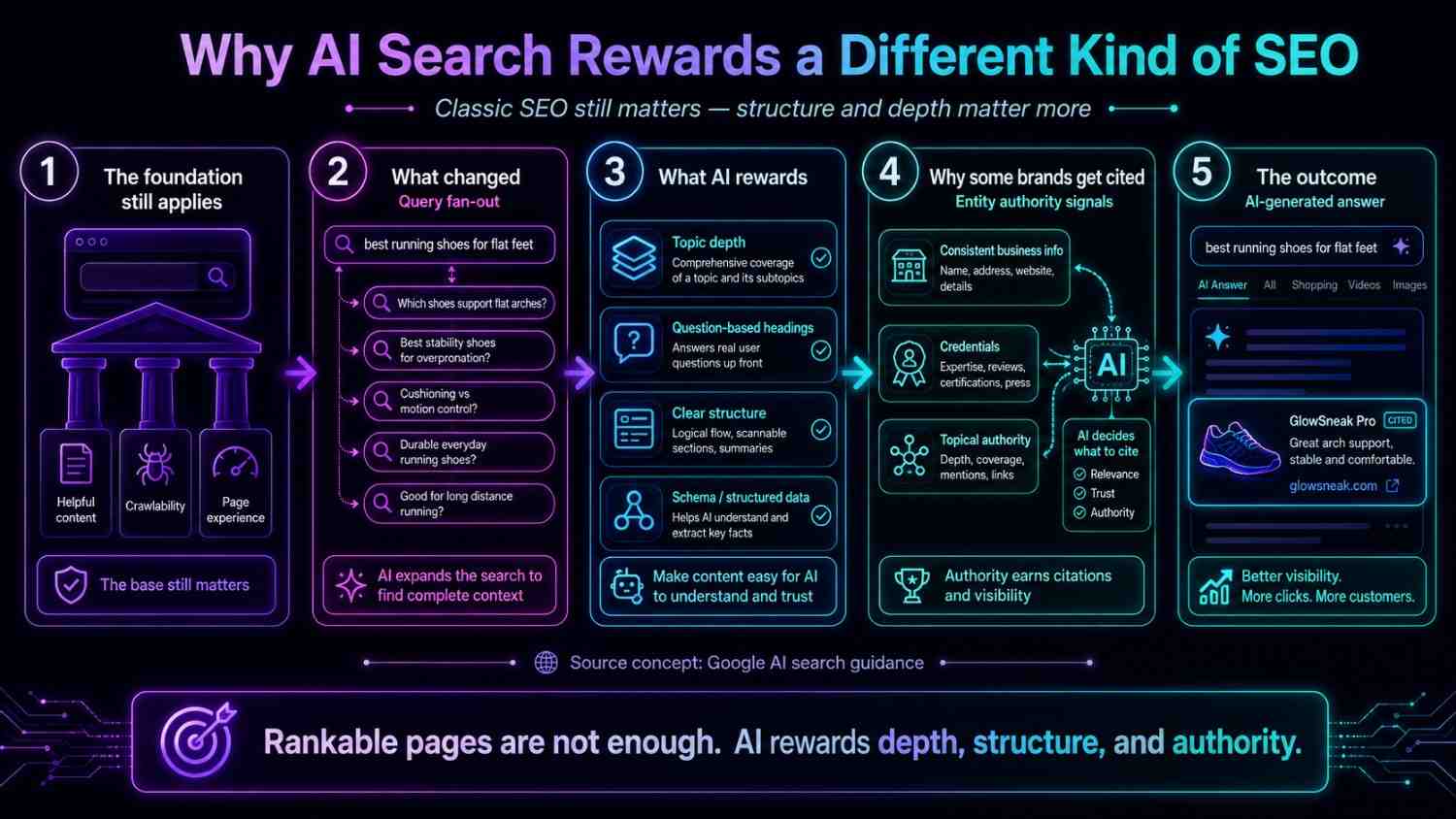
Google is explicit that classic SEO fundamentals still apply — helpful content, crawlability, and strong page experience remain the foundation for both traditional and AI-generated results. What’s changed is depth and structure. Google’s AI systems now run “query fan-out,” generating related sub-queries to pull in more context before forming an answer. That rewards content that thoroughly covers a topic, uses clear headings phrased as real questions, and carries structured data (schema) that machines can parse quickly. Entity signals — consistent business information, credentials, and topical authority — are also becoming a bigger factor in which brands get cited, not just which pages rank.
What’s Trending in Singapore Search This Month
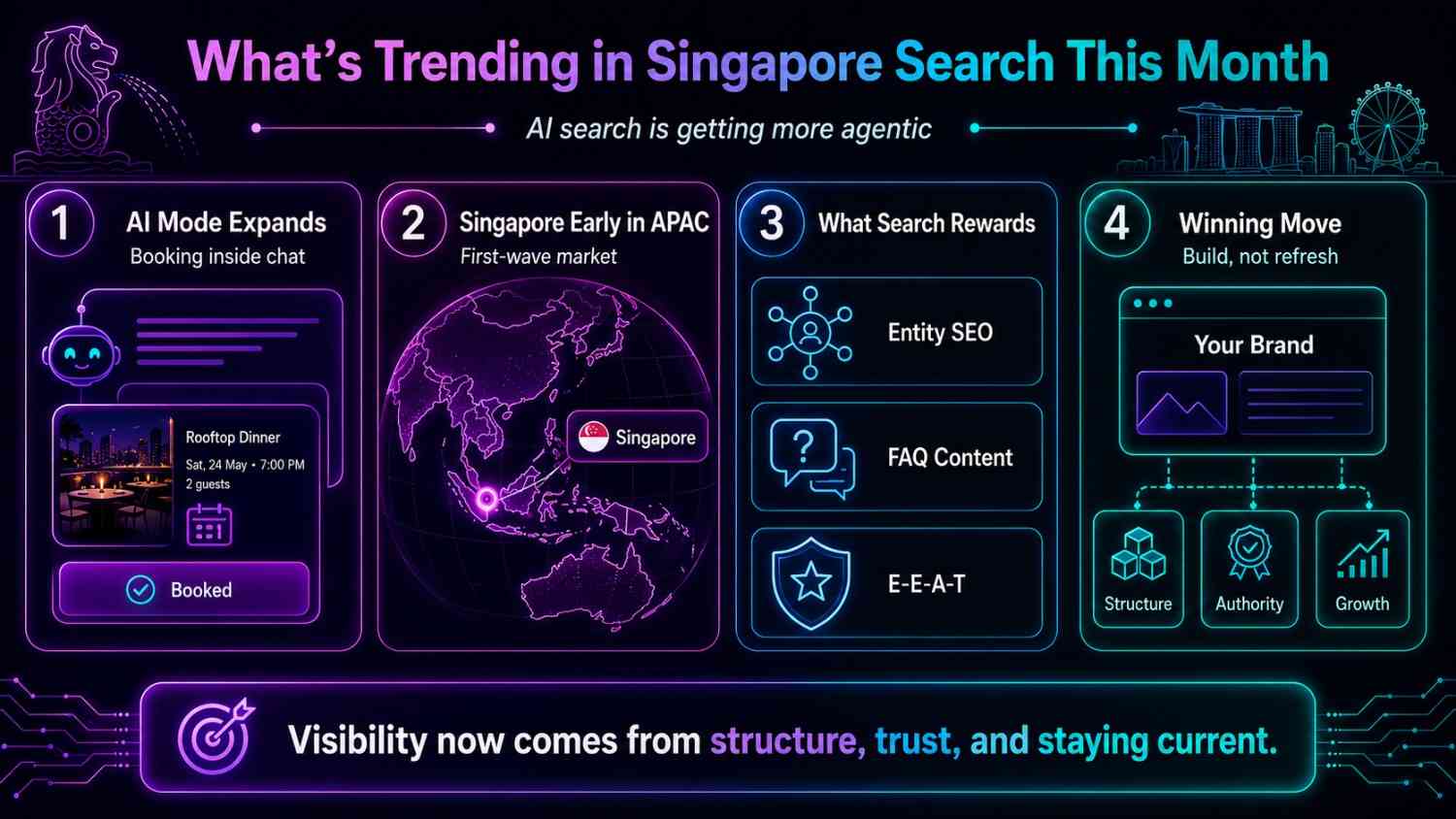
Google has been rolling agentic AI Mode features — including in-chat restaurant booking — into new markets, with Singapore among the first in Asia-Pacific to get them. Locally, this is accelerating a shift already underway toward entity-based SEO, FAQ-structured content, and stronger E-E-A-T signals (AI Studio Singapore SEO Trends 2026). Businesses treating this as an ongoing structural investment, not a one-off content refresh, will stay visible.
From Visibility to Conversion: Why Website Structure Still Wins
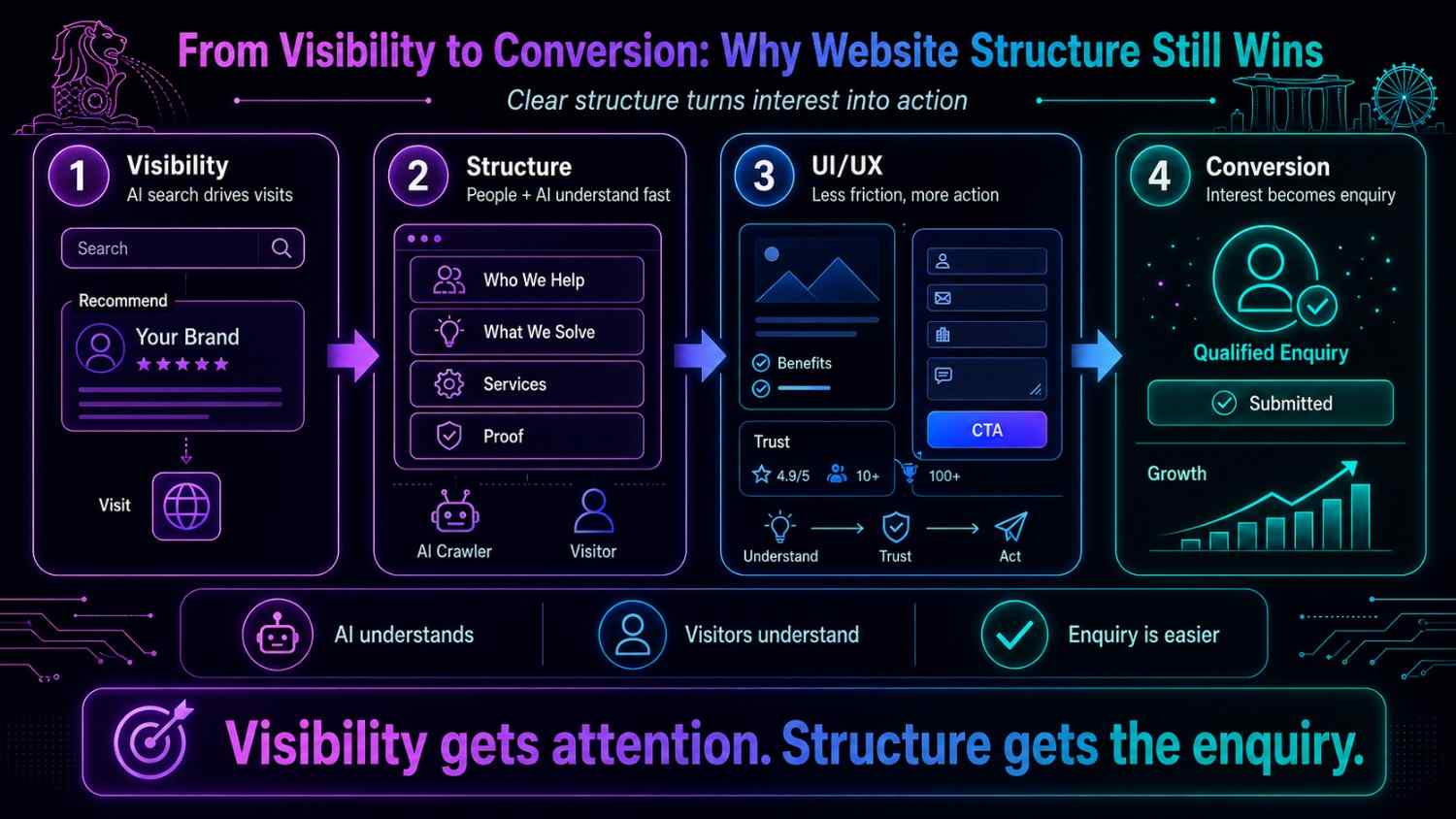
AI visibility only matters if the site behind it can turn interest into action. A clearly structured website helps both AI crawlers and human visitors understand who a business serves, what it solves, and why they should enquire. Strong UI/UX reduces friction at exactly the point a visitor decides to convert — moving them from problem awareness to a completed enquiry through relevant copy, trust signals, and clear calls to action.
How eFusion Technology Helps You Prepare
eFusion Technology has spent over 20 years helping Singapore brands build e-commerce ecosystems connecting owned websites, marketplaces, social commerce, and payment flows — and in 2026, that scope now includes AI search visibility.
Our services cover:
- Shopify and SHOPLINE implementation, plus custom web development for complex needs
- Omnichannel marketplace management connecting your website to Shopee, Lazada, and TikTok Shop
- UI/UX design focused on conversion and reducing checkout friction
- Comprehensive SEO packages — keyword research, technical SEO, content, and local SEO — backed by our Performance Improvement Guarantee
- AEO and GEO strategy, plus AIGC content production, to get your brand cited by ChatGPT, Perplexity, and Google AI Overviews, not just ranked on page one
- Broader growth support through our MEG multi-agency network and our founding membership in the Singapore AI Association (SAIA)
The goal isn’t just launching a store — it’s building a buying journey that shows up everywhere your customer is looking, human or AI.
What Should Singapore Businesses Do Next?
Zero-click search doesn’t make websites less important — it makes them work harder. Start by auditing pages with high impressions but low clicks, strengthen structured data and internal linking, and make sure every high-intent page has an obvious next step. Businesses that combine AI-ready content with a clear, conversion-focused site will be the ones still getting the clicks.
Need to know if your website is ready for AI search? Speak to eFusion Technology for an AI visibility and website structure review.
FAQ
What is zero-click search?
A search where the user gets their answer directly on the results page and never clicks through to a website.
Does Google’s AI Mode reduce website traffic?
It can lower click-through rates for some queries, since answers may appear directly in Search. Pew Research data shows clicks drop from 15% to 8% when an AI summary is present.
Is traditional SEO still relevant for AI search?
Yes. Google states its generative AI features are rooted in core Search ranking systems and rely on indexed, well-structured content.
What is GEO in the context of Singapore SEO?
Generative Engine Optimisation — improving how a brand appears and gets cited inside AI-generated search answers like AI Overviews and AI Mode.
Why is my traffic dropping even though my rankings are stable?
AI summaries, lower click-through rates, layout changes in the SERP, and weak page relevance can all reduce visits even when rankings hold steady.