
As e-commerce matures, business owners face a critical decision: prioritise marketplaces or invest in a dedicated e-commerce platform? Many SMEs in Singapore and Southeast Asia begin on Shopee, Lazada, or Amazon because traction is immediate. Orders can arrive within days, with minimal upfront marketing.
But as revenue scales, so do commission fees, advertising costs, and competitive pressure. What once felt like momentum can quickly turn into dependency.
The real question is no longer where to sell. It is how your chosen channel affects margins, data ownership, and long-term brand equity. Choosing between marketplaces and an e-commerce platform is not a short-term tactic. It is a business model decision that shapes how your brand grows.
Key Takeaways
- Marketplaces accelerate early traction with built-in traffic, logistics, and trust, making them ideal for product validation and fast revenue generation.
- E-commerce platforms build long-term equity by giving you control over pricing, customer data, brand experience, and retention strategies.
- Margins and lifetime value improve when you own customer relationships, not just transactions.
- Hybrid sequencing reduces risk: validate on marketplaces, then strengthen retention and profitability through your own e-commerce platform.
- The right choice depends on growth stage, unit economics, and brand ambition, not simply convenience or speed.
Marketplaces: Fast Traction, Shared Control
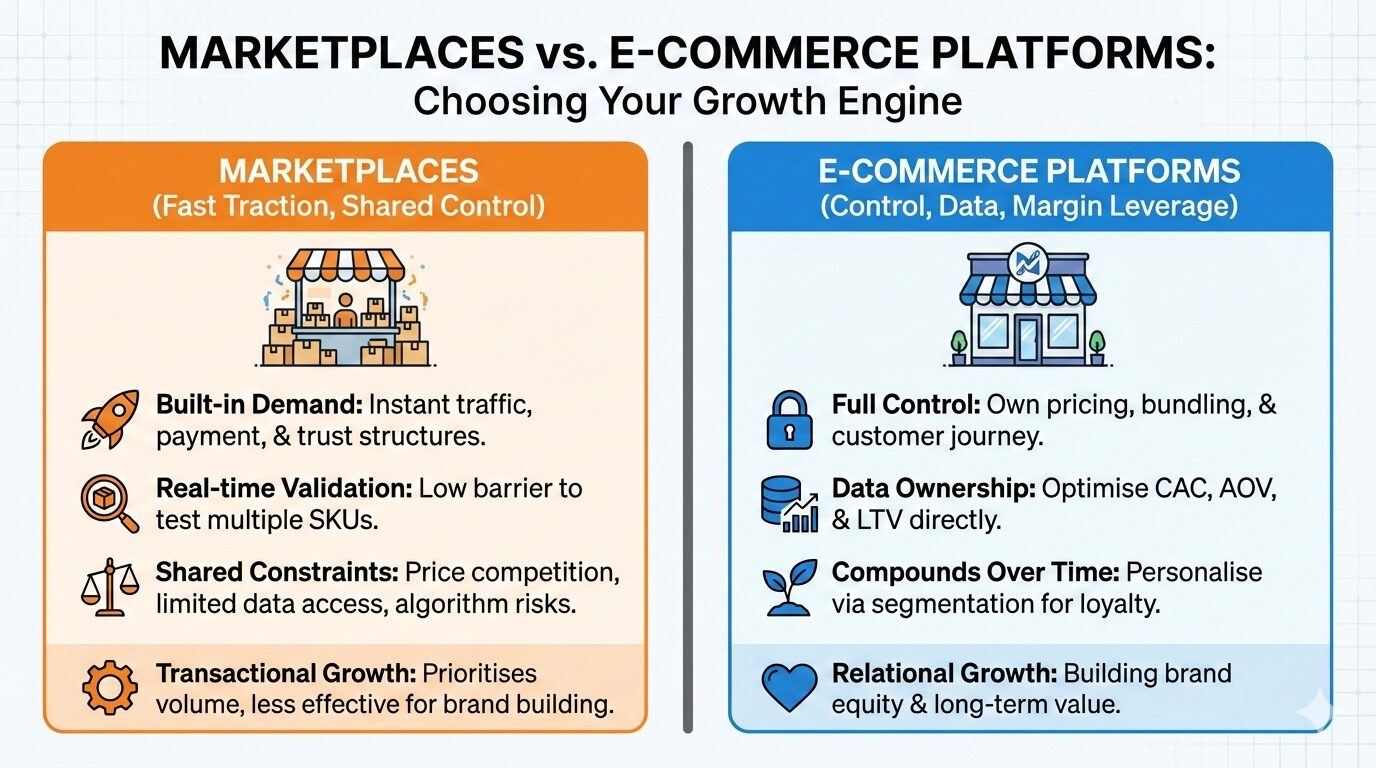
Marketplaces provide built-in demand. They solve traffic, payment infrastructure, and consumer trust from day one.
For early-stage businesses, this lowers barriers significantly. A consumer electronics seller can test multiple SKUs on Amazon without building a website or running complex marketing funnels. In this phase, marketplaces function as real-time demand validation.
However, growth comes with structural constraints:
- You compete beside similar sellers, often on price.
- Sponsored listings become necessary as categories mature.
- Customer data access is limited.
- Algorithm or policy changes can affect visibility overnight.
Marketplaces are strong validation engines. They are less effective brand-building engines. They prioritise transaction volume, not brand equity.
E-Commerce Platforms: Control, Data, and Margin Leverage
You control:
- Pricing structure and bundling logic
- Upselling and cross-selling architecture
- Loyalty and retention programmes
- Customer data capture
- Full customer journey design
For example, a fashion brand with repeat buyers can segment customers based on purchase frequency, send personalised campaigns, and increase repeat purchase rates without paying marketplace commissions on every sale.
When you own the data, you can optimise:
- Customer acquisition cost
- Average order value
- Lifetime value
- Email marketing ROI
Marketplace growth is transactional, E-commerce platform growth is relational. Relational growth compounds over time.
When Each Strategy Makes Sense
Use Marketplaces When:
- You are validating product-market fit.
- Cash flow is urgent.
- Brand differentiation is still developing.
- You want to test cross-border demand with minimal upfront investment.
In this stage, marketplaces act as low-risk testing grounds.
Invest in an E-Commerce Platform When:
- You see repeat purchase behaviour.
- Paid ads are becoming expensive.
- You want to protect margins.
- You are building a long-term brand, not just short-term sales volume.
If customer acquisition costs are rising, shifting retention to an owned platform becomes strategically necessary.
The Smart Approach: Controlled Hybrid Strategy
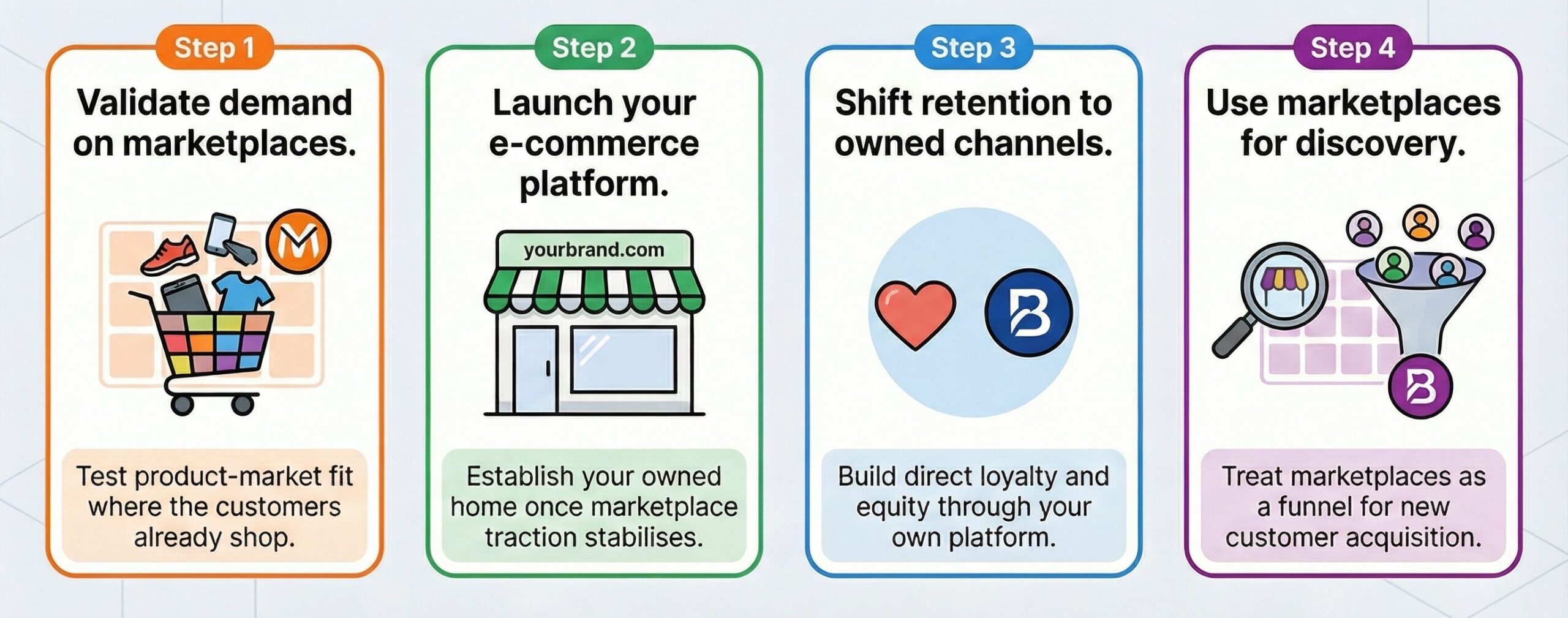
High-growth brands rarely choose one channel permanently. They sequence growth.
- Validate demand on marketplaces.
- Launch an e-commerce platform once traction stabilises.
- Shift retention and loyalty initiatives to the owned channel.
- Use marketplaces for discovery and new customer acquisition.
Over time, this evolves into an omnichannel model where marketplaces and your e-commerce platform are synchronised rather than siloed. Inventory, pricing, and promotions align across channels. Marketplaces drive visibility and first-time buyers, while your e-commerce platform strengthens retention and margin.
The goal is not channel replacement, it is channel optimisation. We will explore omnichannel architecture and integration in greater depth in our next article.
Conclusion
Marketplaces accelerate early traction while E-commerce platforms build equity and margin resilience.
The right decision depends on your growth stage, cost structure, and long-term ambition. For Singapore and Southeast Asia brands navigating rising ad costs and competitive pressure, channel strategy must be deliberate, not reactive.
eFusion Technology, with over 20 years of e-commerce and web development expertise, helps businesses design structured omnichannel growth strategies. From marketplace integration to high-conversion e-commerce platforms, the objective is sustainable, data-driven growth.
If you want clarity on your next growth move, speak with our team for a strategic channel assessment.