
Why is everyone suddenly talking about AEO and GEO?
Over the past year, marketing conversations have shifted from SEO to newer terms like AEO and GEO. For many teams, this creates urgency and confusion at the same time. It feels like the rules have changed overnight.
But they haven’t.
What has changed is how search engines and AI systems interpret, validate, and surface information. The labels are new, but the underlying principles are not.
Key Takeaways
- SEO is still the foundation. Without it, nothing works
- AEO improves clarity, not authority
- GEO depends on external validation, not tactics
- AI favors depth, originality, and trust signals
- The winning strategy is integration, not separation
What is SEO, AEO, and GEO in practical terms?

SEO remains the foundation. It ensures that your website is structured in a way machines can understand. Without proper headings, logical flow, and technical clarity, even the best content struggles to be discovered. As explained in , SEO is less about manipulation and more about translation. It helps machines interpret human intent accurately.
AEO builds on top of that foundation. It focuses on making your content clear enough to be extracted as a direct answer. This is why well-structured explanations and question-based sections perform better today. However, structure alone is not enough. If the content lacks depth, AI systems will simply ignore it.
GEO goes one step further. It is not about your website alone, but about your presence across the digital ecosystem. AI systems look for signals beyond your own domain. They rely on consistency, references, and credibility from multiple sources. Simply repeating your brand message on your own site does not create authority.
What actually drives visibility in 2026?
The real shift is not from SEO to AEO or GEO. It is from optimization to credibility.
Search engines used to prioritize discoverability. Now, AI systems prioritize trust.
This means your content must first be understood, then considered useful, and finally validated externally. If any of these layers are missing, visibility drops.
A technically perfect page without insight will not perform. At the same time, highly insightful content without structure may never surface. The balance is what matters.
When should you focus on AEO vs GEO vs SEO?
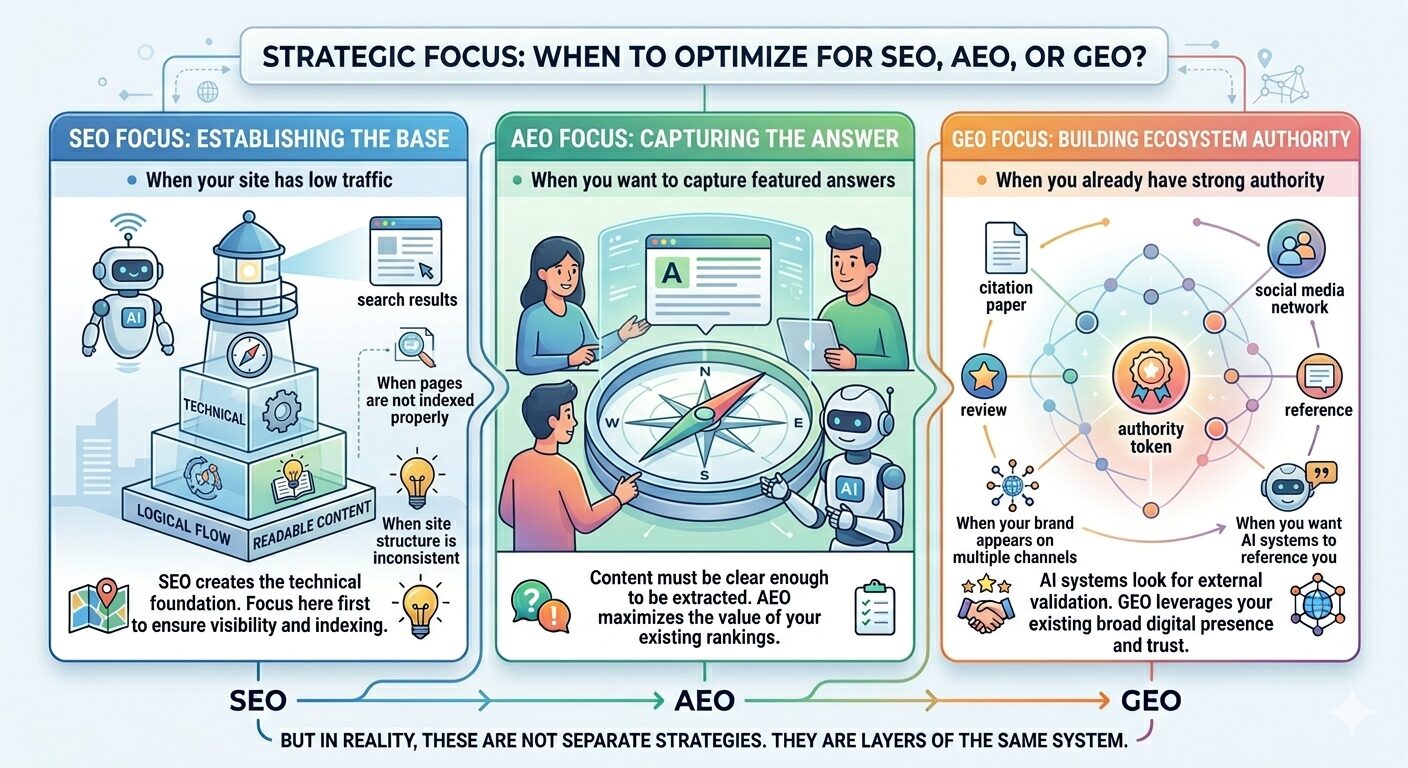
Here’s a practical way to think about it:
Focus on SEO when:
- Your site has low traffic
- Pages are not indexed properly
- Structure is inconsistent
Focus on AEO when:
- You want to capture featured answers
- Your content is already ranking
- You need better clarity and formatting
Focus on GEO when:
- You already have strong authority
- Your brand appears in multiple channels
- You want AI systems to reference you
But in reality, these are not separate strategies.
They are layers of the same system.
Common mistakes businesses make
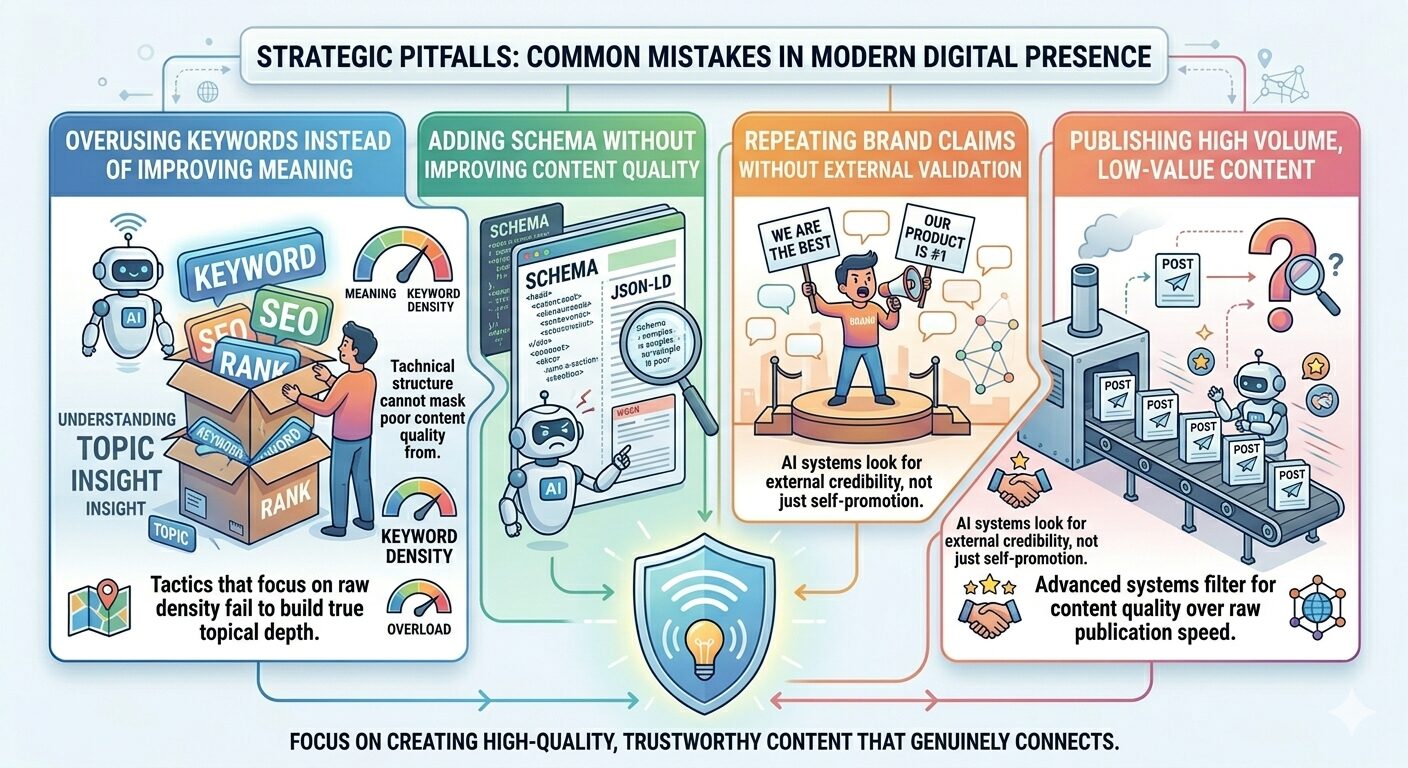
Let’s address what doesn’t work:
- Overusing keywords instead of improving meaning
- Adding schema without improving content quality
- Repeating brand claims without external validation
- Publishing high volume, low-value content
These tactics fail because AI systems prioritize signal strength, not volume.
What is the smarter approach moving forward?
The most effective strategy is not choosing between SEO, AEO, or GEO. It aligns them into a single system.
This starts with a strong technical foundation, so machines can interpret your content. It continues with creating insight-driven content that goes beyond generic advice. Finally, it extends into building authority signals outside your own platform.
The shift is subtle but important. You are no longer just optimizing for search engines. You are building assets that AI systems trust enough to reuse.
How eFusion Technology helps you adapt
At eFusion Technology, we see this transition as a structural problem rather than a tactical one.
Instead of isolating SEO, AEO, or GEO, we help businesses:
- Fix technical SEO foundations
- Redesign content for clarity and depth
- Build authority signals across digital channels
- Align website structure with AI-driven discovery
The goal is not just to increase traffic, but to improve how your brand is understood and referenced in an AI-driven environment.
Conclusion: What should you do next?
Stop asking:
“Should we do SEO, AEO, or GEO?”
Start asking:
“Would an AI trust, understand, and reference our content?”
In 2026, visibility is not driven by who publishes the most or optimizes the hardest. It is driven by who provides the clearest, most credible, and most validated information.
If your content looks like everything else, it will be treated the same way. Contact us so we can help your content be discovered by more people and more visible by AI.
FAQ
Is SEO still relevant in 2026?
Yes. SEO is still the foundation that allows your content to be discovered and interpreted correctly. Without it, AEO and GEO cannot work.
Can AEO replace SEO?
No. AEO builds on SEO. It improves how content is delivered, not how it is discovered.
How does GEO actually work?
GEO relies on external validation. Your brand must be mentioned and recognized across multiple trusted sources.
What is the biggest mistake companies make today?
Focusing on tactics instead of building real authority and insight.