

Not sure which e-commerce SaaS platform is suitable for your business in Singapore? It is a common question for businesses launching online or reviewing an existing store. While many platforms promise fast setup and easy management, choosing the wrong one can limit growth later.
The right platform depends less on popularity and more on how well it supports your products, customers, and long-term plans. Below are five e-commerce SaaS platforms commonly used in Singapore, with practical guidance on when each makes sense.
How to assess and choose the right SaaS platform for e-commerce
Before choosing a platform, consider these key questions:
- Can the platform adapt to your pricing rules, product types, or customer segments?
- Does it support selling across web, social, marketplaces, and mobile?
- Can it handle multiple currencies, languages, and regional requirements?
- Is there reliable technical support and a strong partner ecosystem?
- How quickly can you launch or migrate from an existing system?
- Does it provide clear reporting on sales, traffic, and customer behaviour?
Top 5 E-commerce SaaS Platforms in Singapore
1. Shopify

Overview Shopify is one of the most widely used global ecommerce SaaS platforms, designed specifically for selling online and built for growth.
Best for: Brands that plan to scale quickly and expand internationally
Pros
- Platform adaptability: Highly adaptable with thousands of apps and APIs for complex pricing, segments, and product types.
- Multi-channel readiness: Natively connects to social, marketplaces, POS, and mobile channels.
- Internationalisation: Strong support for multi-currency, tax, and global selling channels.
- Technical support & ecosystem: 24/7 support plus a large partner and developer community.
- Time to launch: Quick deployment with guided onboarding and templates.
- Strong Global Infrastructure: Robust global infrastructure to support international businesses.
- Headless & API Flexibility: Flexible for developers to create custom front‑end experiences.
- Enterprise Upgrade Path (Shopify Plus): Scalable solution for large enterprises.
Cons
- Cost scaling: Add-on apps and higher plans increase total ownership cost.
- Reporting & analytics: Built-in analytics are useful but deeper insights often require apps or higher tiers.
2. Wix eCommerce
Overview Wix eCommerce combines a flexible drag-and-drop site builder with ecommerce functionality, ideal for smaller businesses and visually driven stores.
Best for: Creative entrepreneurs and small businesses with simple product catalogs
Pros
- Time to launch: Very fast setup with intuitive builder and hosting included
- Ease of use: User-friendly visual interface suitable for teams with limited technical skills
- Support ecosystem: Good documentation and community tutorials
- Multi-channel readiness: Supports basic social and web channels
Cons
- Platform adaptability: Less suited for complex pricing, customer segments, or enterprise needs
- Internationalisation: Limited multi-currency and language capabilities
- Reporting & analytics: Basic analytics; advanced insights may require third-party tools
3. Squarespace

Overview Squarespace is a design-first ecommerce platform and website builder suited to brands where aesthetics and content presentation matter.
Best for: Lifestyle, creative, and professional brands focused on visual presentation
Pros
- Design-ready launch: Beautiful templates and fast site build time
- Ease of use: Intuitive editor with built-in SEO and marketing features
- Support ecosystem: Solid Help Center and guides
Cons
- Platform adaptability: Limited support for complex workflows and custom pricing
- Multi-channel readiness: More basic than Shopify or BigCommerce
- Internationalisation: Less extensive multi-currency and language support
- Reporting & analytics: Standard analytics; deeper insights require external tools
4. Shopline
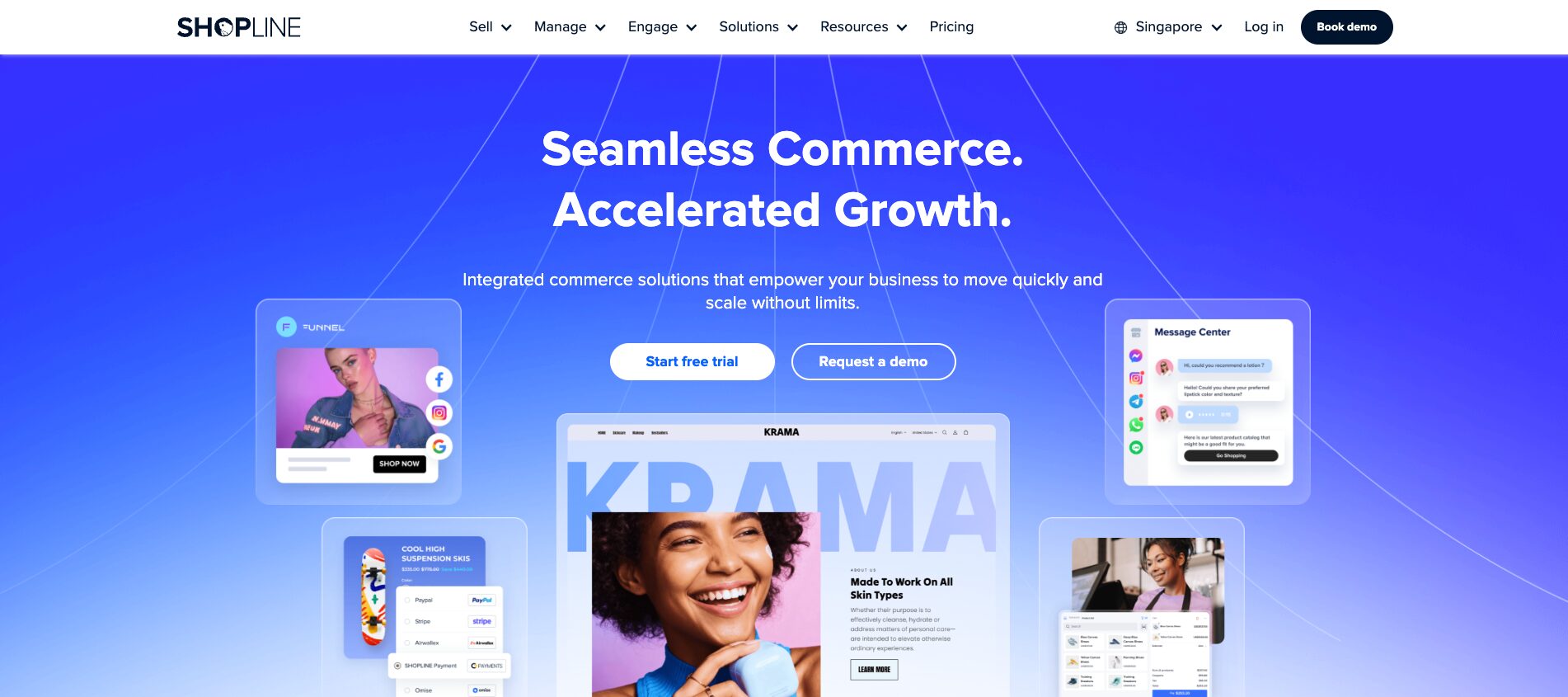
Overview Shopline is an Asia-focused unified commerce platform designed for regional merchants selling across online and social channels.
Best for: SMEs and social commerce sellers targeting Southeast Asia or Asia-Pacific markets
Pros
- Multi-channel readiness: Unified sales across web, social, and marketplaces.
- Internationalisation: Supports multi-currency and multi-language storefronts.
- Reporting & analytics: Built-in analytics and unified order insights.
- Time to launch & migration ease: Easy setup with templates and native admin tools.
- Asia-First Architecture: Designed specifically for businesses in the Asian market.
- Native Live Commerce: Integrated live streaming and commerce features for the region.
- Strong Social Commerce Integration: Direct integrations with social platforms like Facebook and Instagram.
- Built-In Membership & CRM: Ready-to-use customer relationship tools.
- OMO POS Integration: Seamless integration for online and offline sales channels.
- Promotion & Campaign Engine for Asian Markets: Optimised tools to run regional marketing campaigns.
Cons
- Technical support & ecosystem: Smaller global partner ecosystem than global leaders such as Shopify.
- Platform adaptability: Fewer third-party extensions compared to Shopify’s large marketplace.
5. BigCommerce
Overview BigCommerce is a scalable ecommerce platform built for performance, extensibility, and complex business requirements.
Best for: Growing mid-market and enterprise brands with large catalogs or B2B needs
Pros
- Platform adaptability: Strong built-in support for complex workflows
- Multi-channel readiness: Omnichannel selling across web, marketplaces, and POS
- Internationalisation: Excellent multi-currency and multi-region capabilities
- Technical support & ecosystem: Dedicated support and certified partners
- Reporting & analytics: Advanced dashboards for sales and customer behaviour
Cons
- Time to launch: Longer setup for complex stores
- Ease of use: May require training or technical support
Platform selection is only the first step
The right SaaS platform provides the foundation, but results depend on structure, clarity, and execution.
At eFusion Technology, we help Singapore businesses select the right platform, design seamless UI and clear information structure, and build SEO-ready, scalable e-commerce foundations. If you are evaluating a platform or planning a migration, get in touch with us to explore the right direction for your business.