

Should a Singapore brand pour budget into TikTok Shop and Shopee, or invest in its own website? In 2026, that’s the wrong question. Singapore’s e-commerce market is forecast to grow 17.7% this year to roughly SGD 40.5 billion (US$31 billion), heading to nearly SGD 63 billion by 2030 (Osome, 2026). The real question is which channel does which job — and how your brand shows up inside ChatGPT, Perplexity, and Google AI Overviews when asked “what’s the best [category] brand in Singapore?”
The right answer is still omnichannel, not a single platform. But why an owned website matters in 2026 has changed: it’s not just about SEO rankings anymore — it’s about becoming the source AI engines trust enough to cite.
Key Takeaways
- Social commerce (TikTok Shop, Instagram, live shopping) drives discovery and impulse purchases.
- Marketplaces like Shopee and Lazada support reach, reviews, and price comparison.
- An owned website protects brand control, first-party data, and long-term SEO/AEO visibility.
- AI search (AEO/GEO) now matters as much as traditional SEO — zero-click searches have passed 65% in Singapore, and AI Overviews trigger on 40–60% of queries (AI Studio, 2026).
- Omnichannel e-commerce connects discovery, trust, payment, AI visibility, and repeat sales into one system.
Social Commerce vs. Your Own Website
Social commerce means selling through TikTok Shop, Instagram, Facebook, and live shopping, while marketplaces like Shopee and Lazada support discovery and one-tap purchasing. An owned website — on Shopify, SHOPLINE, WooCommerce, or custom development — gives brands what those platforms can’t: full control over content, journey, checkout, SEO, data, and loyalty.
Why This Matters More in 2026: The AI Search Shift
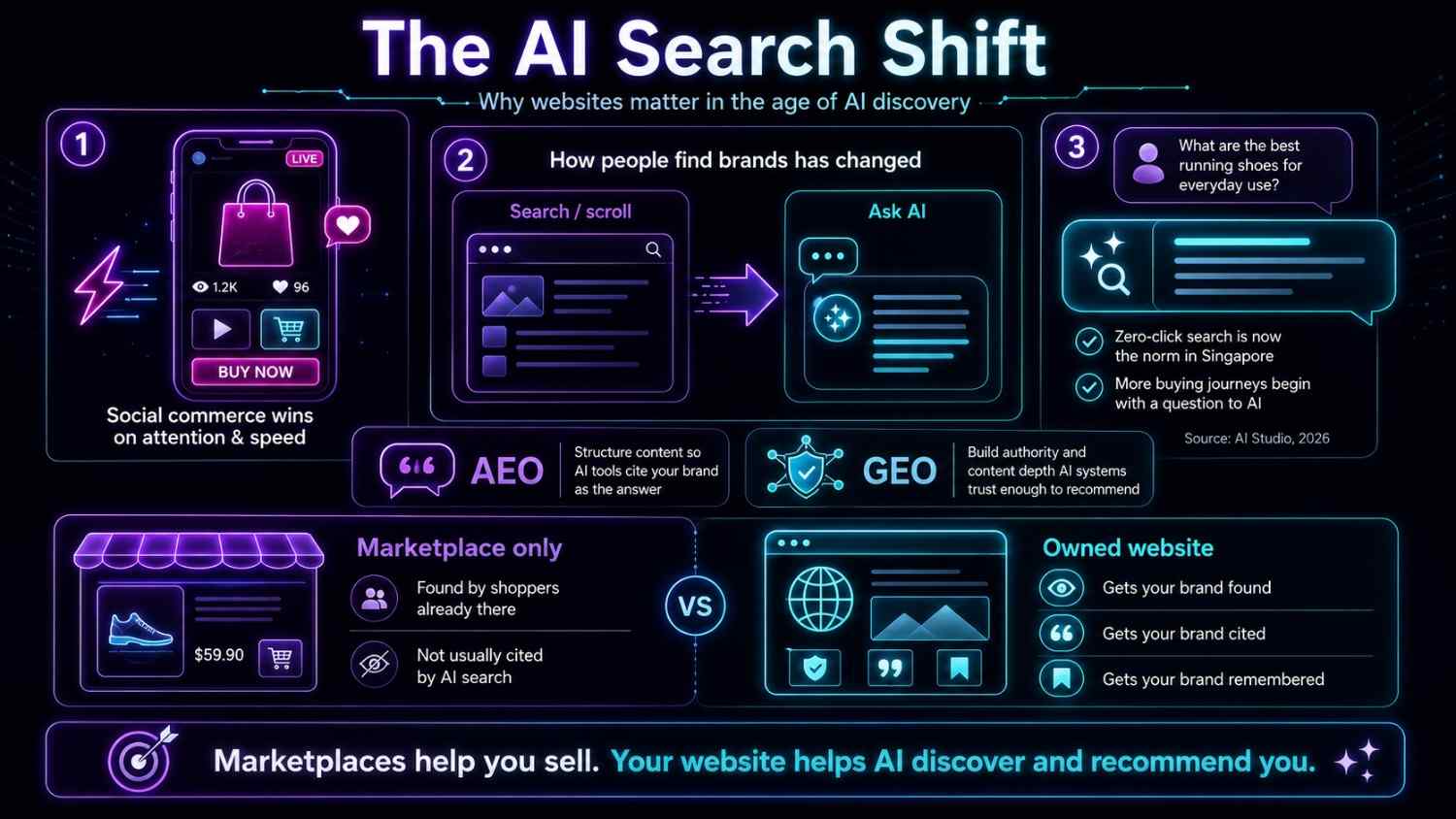
Social commerce still wins on attention and speed. But something bigger has shifted: how people find brands at all. Zero-click search is now the norm in Singapore, and a growing share of buying journeys start with a question asked to an AI assistant rather than a Google scroll (AI Studio, 2026). This has created two disciplines alongside SEO:
- Answer Engine Optimisation (AEO) — structuring content so AI tools cite your brand as the direct answer.
- Generative Engine Optimisation (GEO) — building the entity authority and content depth AI systems trust enough to recommend.
Here’s the catch: TikTok Shop and Shopee listings aren’t cited the way an owned website is. If your storefront lives only on a marketplace, you’re invisible to AI search, no matter how good the product is. Marketplaces get you found by shoppers already there. Your website gets you found, cited, and remembered everywhere else.
Conversion and AI-Visibility: How a Website Improves Sales
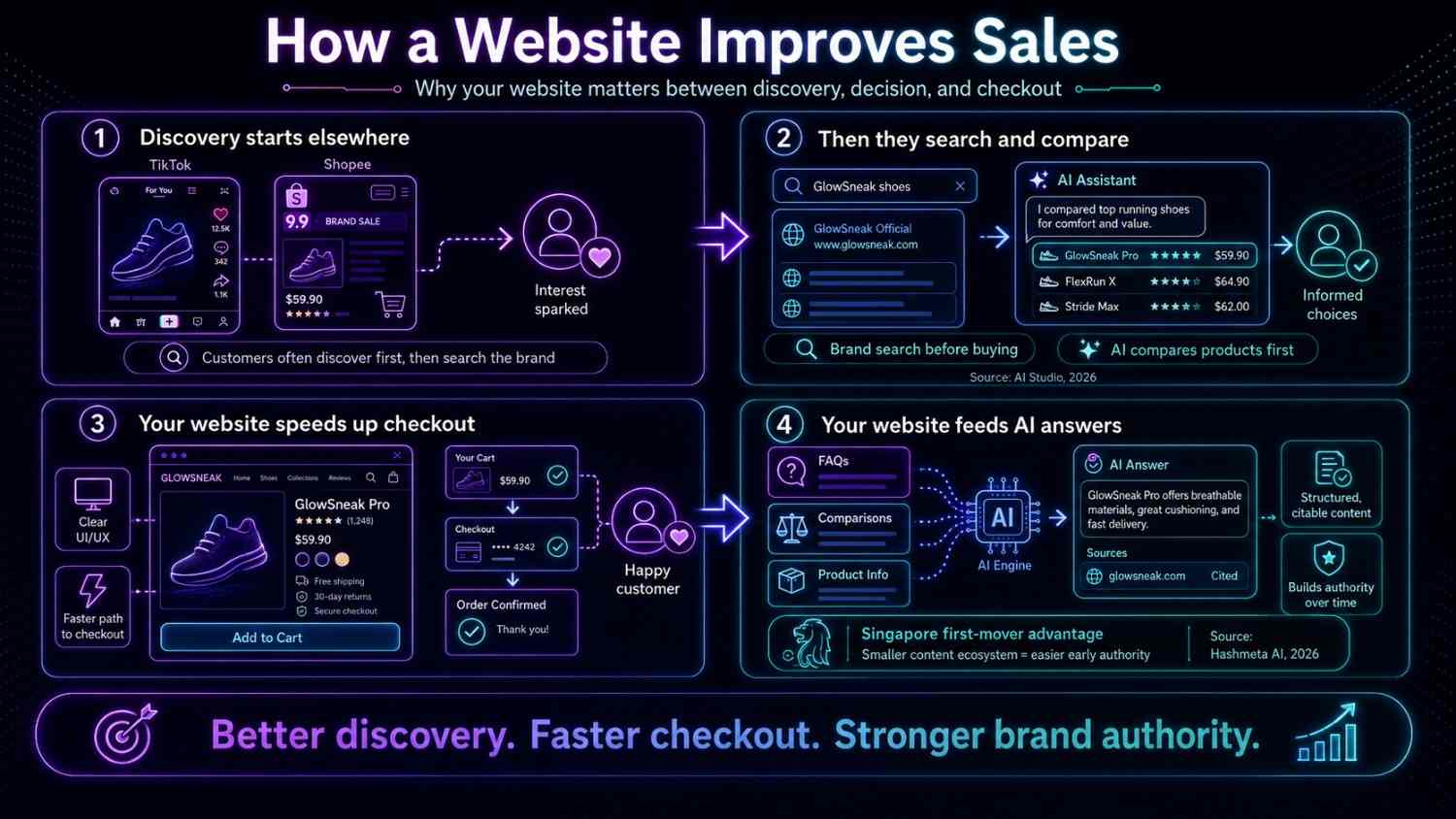
When a customer discovers a product on TikTok or Shopee, they often search the brand name before buying — and increasingly ask an AI assistant to compare it first. Two things matter here: clear UI/UX that gets customers to checkout faster, and structured, citable content (FAQs, comparisons, organised product info) — exactly what AI engines pull from when generating an answer (AI Studio, 2026). Singapore’s smaller content ecosystem also means brands that move first can build authority competitors struggle to catch later (Hashmeta AI, 2026).
How Should Brands Build This?
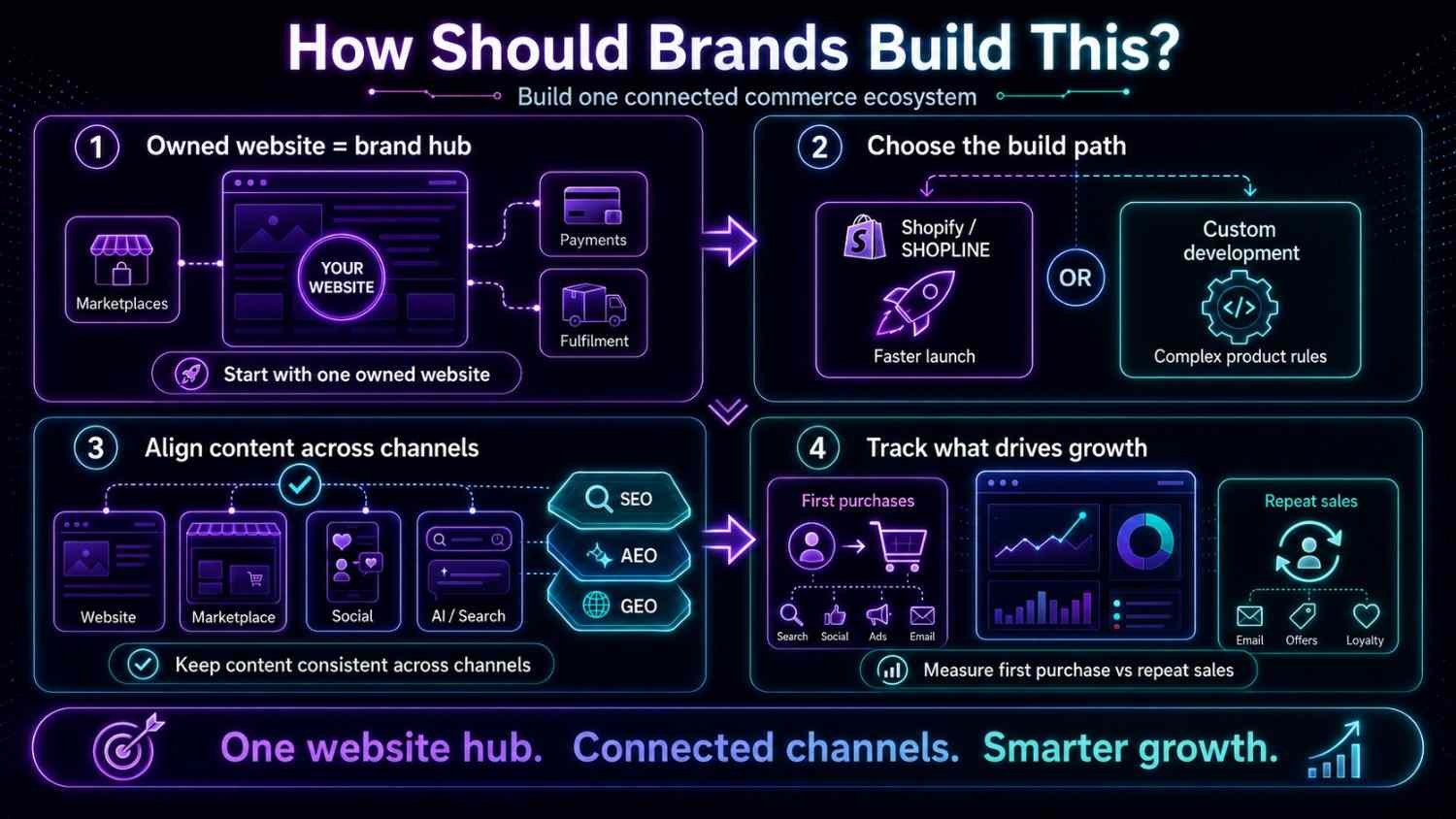
Start with one owned website as the brand hub, then connect it to marketplaces, payments, and fulfilment. Use Shopify or SHOPLINE for faster launch, or custom development for complex product rules. Keep content consistent across channels, layer SEO, AEO, and GEO together, and track which channels drive first purchases versus repeat sales.
How eFusion Technology Can Help
eFusion Technology has spent over 20 years helping Singapore brands design and build e-commerce ecosystems that connect owned websites, marketplaces, social commerce, and payment flows — and in 2026, that scope now includes AI search visibility.
Our services cover:
- Shopify and SHOPLINE implementation, plus custom web development for brands with complex needs
- Omnichannel marketplace management connecting your website to Shopee, Lazada, and TikTok Shop
- UI/UX design focused on conversion and reducing checkout friction
- Comprehensive SEO packages — keyword research, technical SEO, content, and local SEO — backed by our Performance Improvement Guarantee
- AEO and GEO strategy, plus AIGC (AI-generated content) production, to help your brand get cited by ChatGPT, Perplexity, and Google AI Overviews, not just ranked on page one
- Broader growth support through our MEG multi-agency network and our position as a founding member of the Singapore AI Association (SAIA), bringing the latest AI tooling directly into your digital strategy
The goal isn’t just launching a store — it’s building a buying journey that shows up everywhere your customer is looking, human or AI.
Conclusion: What Should Singapore Brands Build in 2026?
Social commerce and marketplaces are valuable for reach. Your own e-commerce website is valuable for control, trust, first-party data, and now, AI search visibility. The strongest strategy connects all of it into one system rather than treating each channel as a silo.
Talk to eFusion Technology about building an e-commerce setup that connects your website, marketplaces, social commerce, and AI search visibility into one coordinated growth engine.
FAQ
Is TikTok Shop better than Shopify in Singapore?
TikTok Shop is stronger for discovery and impulse buying. Shopify (or SHOPLINE) is stronger for owned brand control, SEO/AEO visibility, customer data, and long-term conversion.
Should Singapore brands still sell on Shopee?
Yes. Shopee supports reach and marketplace demand, but it shouldn’t be the only customer touchpoint — especially since marketplace listings aren’t cited by AI search engines the way an owned website’s content is.
Why does a brand need its own e-commerce website in 2026?
It builds trust, explains products clearly, collects first-party customer data, improves SEO and AI-search visibility, and supports repeat purchases — none of which a marketplace listing can fully deliver.
What is omnichannel e-commerce in Singapore?
It means connecting your website, marketplaces, social commerce, payments, fulfilment, and customer data into one coordinated sales journey.
What’s the difference between SEO, AEO, and GEO?
SEO focuses on ranking in traditional search results. AEO (Answer Engine Optimisation) focuses on getting your content selected as a direct answer by AI tools. GEO (Generative Engine Optimisation) focuses on getting your brand cited or recommended inside AI-generated responses. In 2026, the strongest strategies combine all three.
Which platform should Singapore SMEs use for e-commerce?
Shopify and SHOPLINE are practical for most SMEs. Custom development is better when complex integrations or advanced workflows are required.