
Why are Singapore businesses still struggling with SEO today?
Many Singapore businesses are investing in SEO, yet results feel inconsistent or underwhelming. The issue is rarely effort. It is usually direction.
Most strategies still reflect how search worked five or ten years ago. Back then, success often came from targeting keywords, publishing frequently, and optimizing technical elements. Today, that approach is no longer enough.
Search engines and AI systems now prioritize meaning, credibility, and usefulness. As explained in , SEO has never truly been about tricking systems. It is about helping machines understand and trust your content.
If your strategy has not adapted, you are likely making one of the following mistakes.
Key Takeaways
- SEO has shifted from keywords to meaning and intent
- Generic content is increasingly ignored
- Technical SEO supports visibility but does not guarantee trust
- External authority plays a larger role in rankings
- Long-term success depends on credibility, not shortcuts
What has changed in SEO in the AI era?
SEO is no longer just about ranking pages on Google. It is about becoming a trusted source that AI systems choose to reference or summarize.
This means your content must do more than exist. It must demonstrate clarity, real expertise, and relevance to actual business problems. In short, visibility now follows trust.
Mistake #1: Treating SEO as a keyword exercise
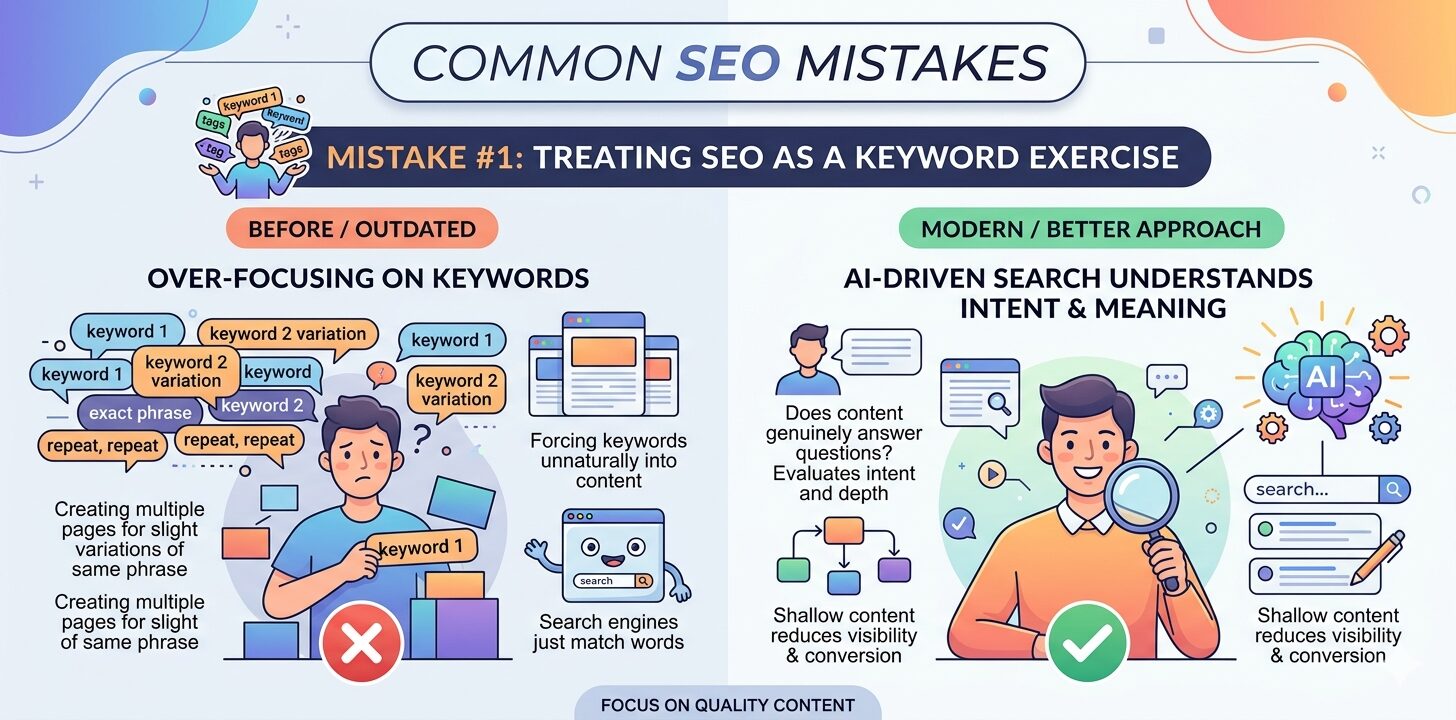
A common issue is over-focusing on keywords as if they are the primary ranking factor.
Many websites still create multiple pages targeting slight variations of the same phrase, or force keywords unnaturally into content. This approach assumes that search engines are matching exact terms.
They are not.
AI-driven search understands intent and meaning. It evaluates whether your content genuinely answers a question, not whether it repeats a phrase.
When content is written purely around keywords, it often becomes shallow and unhelpful. This reduces both visibility and conversion.
Mistake #2: Publishing content that adds no new insight
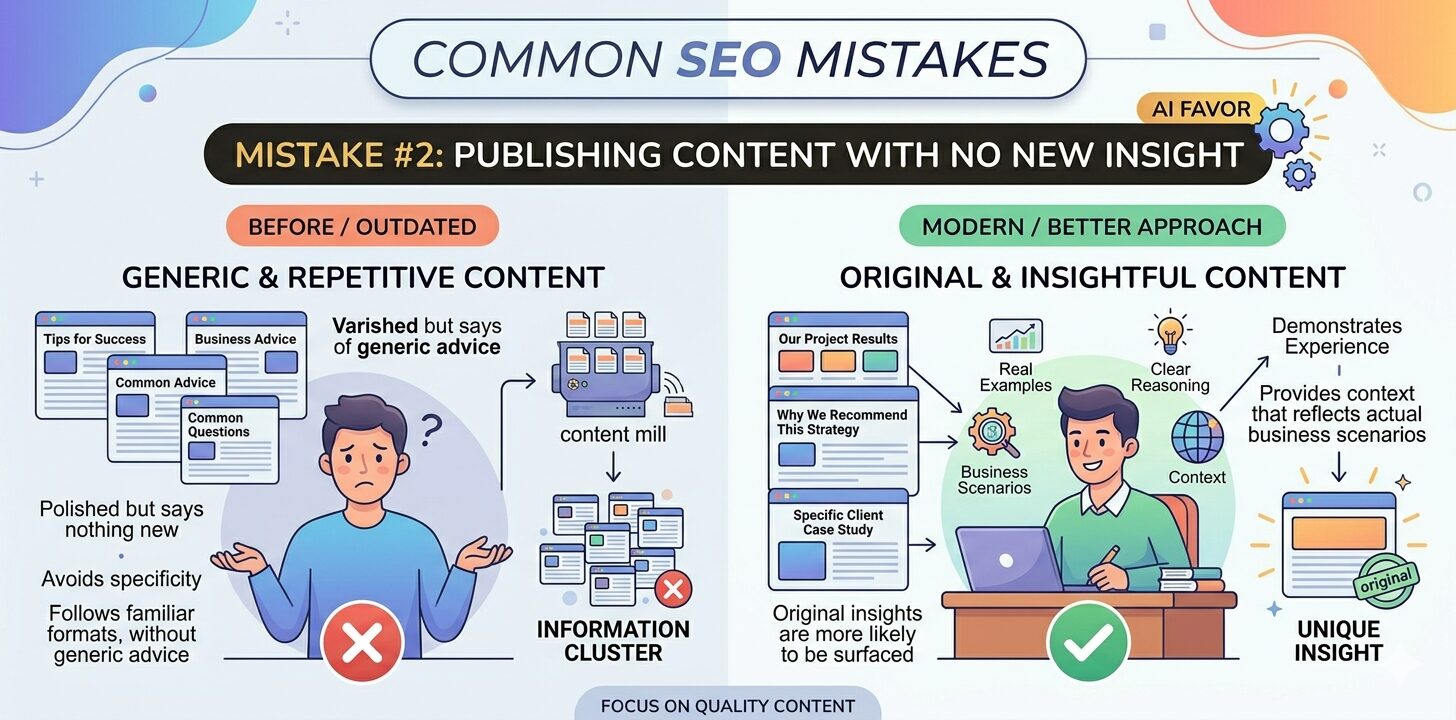
Another pattern we see across Singapore SMEs is content that looks polished but says nothing new.
It follows familiar formats, repeats widely available advice, and avoids specificity. While this may have worked when content volume alone could drive rankings, it no longer stands out.
AI systems tend to favour content that demonstrates experience. This includes real examples, clear reasoning, and context that reflects actual business scenarios.
As highlighted in , generic content tends to blend into the same “cluster” of information, while original insights are more likely to be surfaced.
Mistake #3: Relying on technical SEO without depth
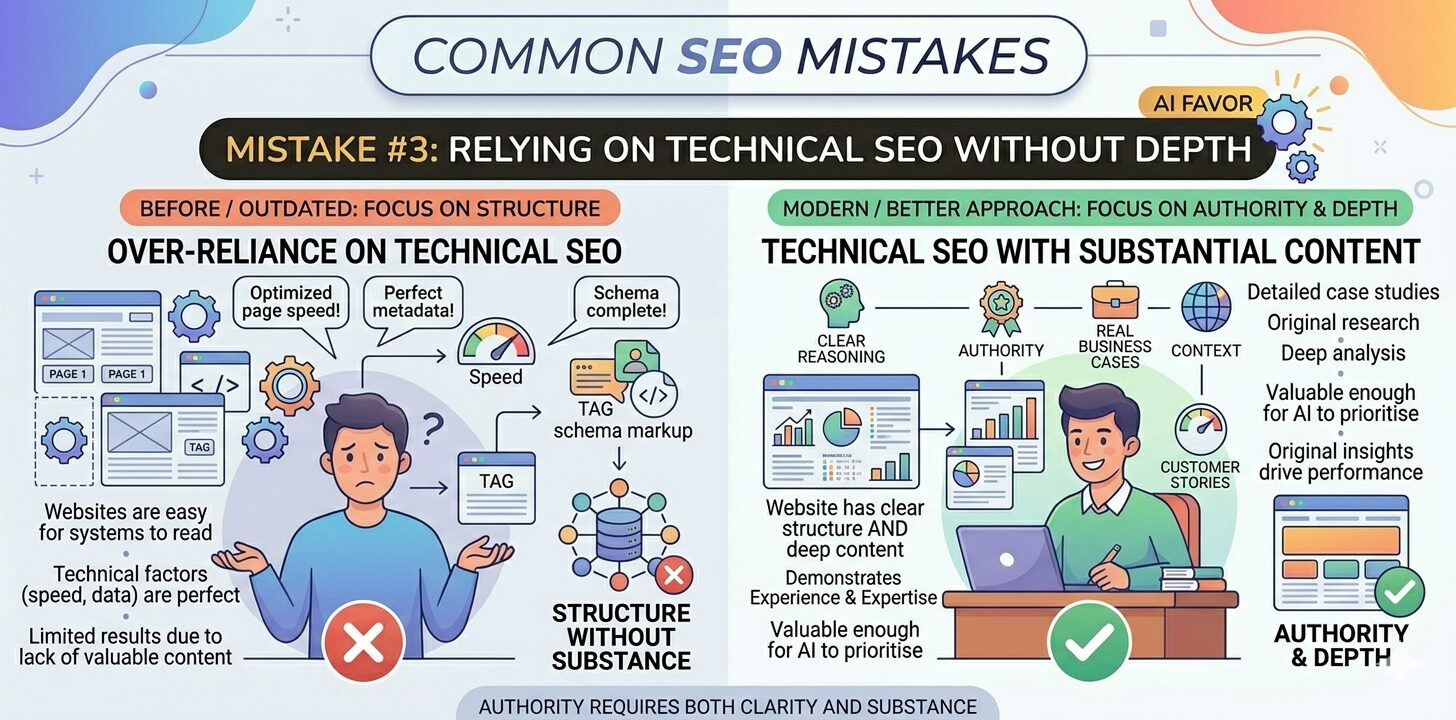
Technical SEO is still necessary. A well-structured website helps search engines understand your content more effectively. However, structure alone does not create authority.
Many businesses invest in improving page speed, metadata, and schema, but see limited results because the content itself lacks depth. In simple terms, the system can read the page, but it does not find it valuable enough to prioritise.
Effective SEO today requires both clarity and substance. Without both, performance will stall.
Mistake #4: Building authority only on your own website
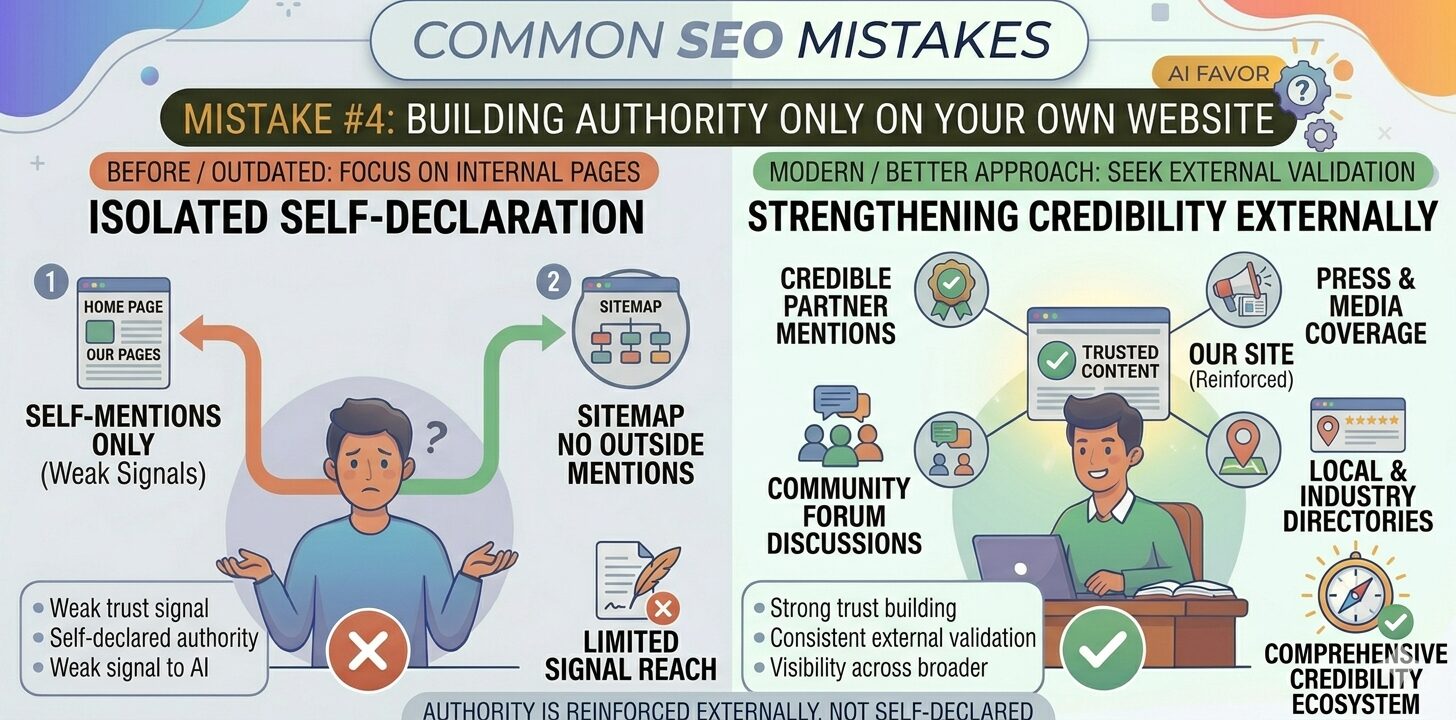
A common misconception is that SEO happens entirely within your website. In reality, authority is increasingly shaped by external validation. If your brand is only mentioned within your own pages, the signal is weak.
AI systems look for consistency across sources. When your business is referenced by other credible platforms, it strengthens trust. As noted in , authority is not self-declared. It is reinforced externally.
For Singapore businesses, this often means going beyond content production and investing in visibility across the broader digital ecosystem.
Mistake #5: Looking for shortcuts to “hack” AI
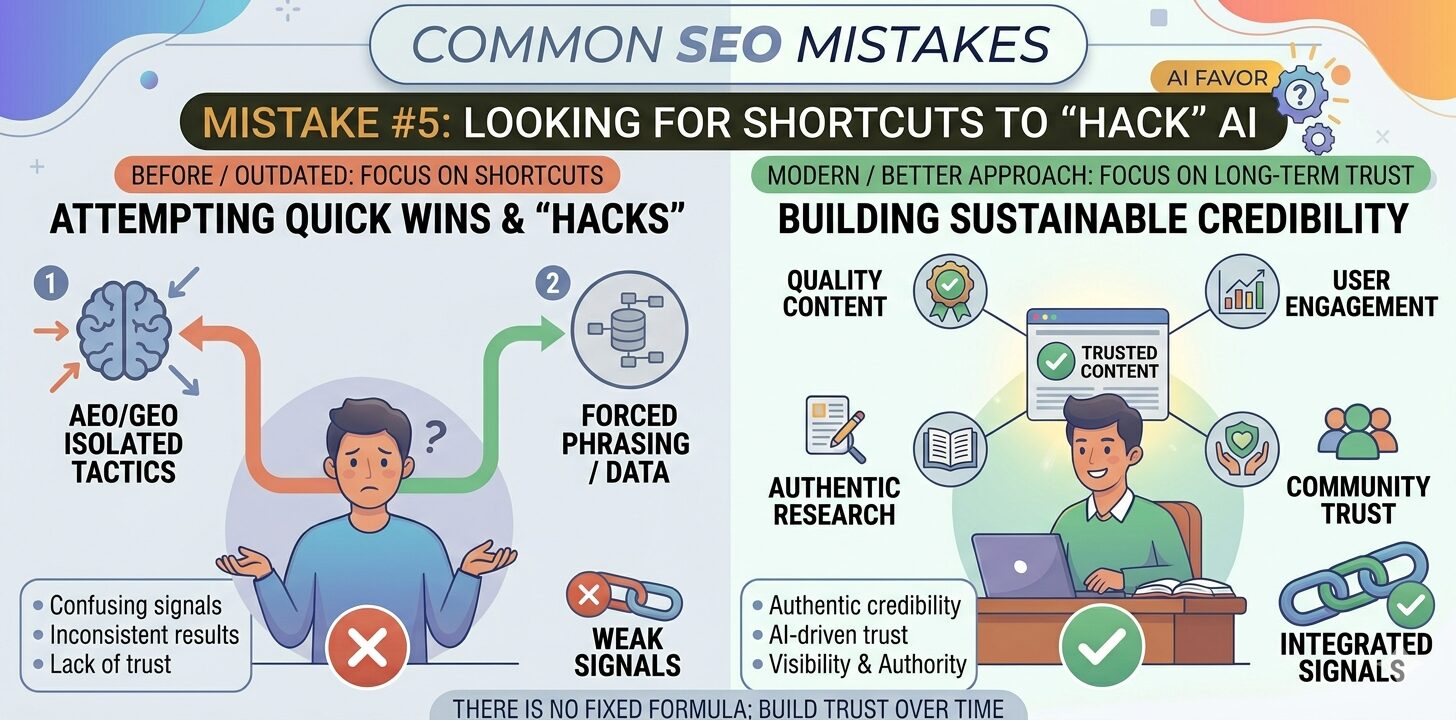
There is growing interest in tactics labelled as AEO or GEO. While these ideas are useful in framing how search is evolving, they have also created confusion.
Some businesses assume there are quick wins, such as adding more structured data or adjusting phrasing to sound more conversational. The reality is that there is no fixed formula.
AI systems are constantly evolving and rely on multiple signals, including content quality, relevance, and credibility. Shortcuts tend to produce inconsistent results at best. The more sustainable approach is to focus on building trust over time.
What should Singapore businesses do differently?
The shift required is not about abandoning SEO, but about refining it.
Instead of asking how to rank higher, the better question is whether your content would be considered useful and credible enough to be referenced.
This requires a stronger connection between your content, your expertise, and your overall digital presence.
How eFusion approaches SEO in the AI era
At eFusion Technology, SEO is not treated as a standalone tactic. It is part of a broader strategy that combines technical clarity, content depth, and authority building.
This typically involves:
- Structuring websites so they are easily understood by search systems
- Developing content that reflects real business insights, not generic advice
- Strengthening brand signals beyond the website through strategic visibility
The goal is not just to improve rankings, but to position your business as a reliable source within your industry.
Conclusion: SEO is no longer about visibility alone
The businesses that perform well today are not necessarily the ones producing the most content. They are the ones producing the most meaningful content, supported by credible signals.
If your current strategy still revolves around keywords and volume, it may be time to reassess.
A practical starting point is to review your key pages and ask whether they genuinely provide value, or simply repeat what is already available.
If you are looking to align your SEO strategy with how search actually works today, eFusion Technology can help you identify the gaps and build a more sustainable approach.
FAQ
Is SEO still relevant for Singapore businesses?
Yes, but the approach needs to evolve to focus on intent, authority, and content quality.
How long does it take to see results?
Most businesses see directional improvements within a few months when strategy and execution are aligned.
Do I need to change my entire website?
Not always. In many cases, improving existing high-value pages can deliver meaningful results.