

In the fast-growing Southeast Asia startup ecosystem, ambition is never in short supply. The region is booming with innovation, from fintech disruptors in Singapore to social commerce pioneers in Indonesia. But for every startup that succeeds, dozens fall short because they built too much, too soon. The question most founders face early on is simple but critical: Should you launch a Minimum Viable Product (MVP) or go straight to a full product?
At eFusion Technology, we’ve guided many startups across Southeast Asia through this very decision. The answer almost always depends on timing, validation, and scalability, and more often than not, an Minimum Viable Product (MVP) is the smarter path.
Understanding MVP Development vs Full Product for Southeast Asia Startups
A Minimum Viable Product (MVP) is a focused version of your idea that contains only the core features necessary to deliver value to users. It’s designed to test market demand quickly and cost-effectively, allowing founders to gather insights, validate assumptions, and iterate before committing to a large-scale build.
A full product, on the other hand, represents the fully realised version of your vision, complete with branding, complex integrations, and scalability. This approach is better suited for companies that already have validated traction and proven market fit.

For Southeast Asia startups, where consumer behaviour, payment preferences, and even languages differ dramatically from country to country, starting lean with an MVP provides agility. It allows you to localise fast, minimise cost, and adapt based on real-world feedback rather than guesswork.
The Risks of Building a Full Product Too Early in Southeast Asia
It’s natural for ambitious founders to want to launch a complete platform right away. However, in Southeast Asia’s fast-moving digital economy, that can be a costly mistake.
Many startups over-invest in development before confirming demand. They spend months perfecting features users never ask for, polishing designs, and scaling infrastructure for traffic that never comes. What resonates with customers in Singapore might fall flat in Thailand or the Philippines, and by the time those lessons surface, budgets are already depleted.
Beyond wasted time and capital, building a full-scale product too soon limits flexibility. Once complex systems are in place, major pivots become expensive and slow. Investors, too, are cautious of startups that overspend before proving traction, they prefer to see a working MVP that validates market potential. Launching lean first enables startups to test smarter, learn faster, and pivot early, all essential traits in Southeast Asia’s unpredictable digital landscape.
Why MVP Development Works Best for Southeast Asia Startups
Southeast Asia is a region defined by diversity and speed. Each market, Singapore, Indonesia, Malaysia, Vietnam, Thailand, and the Philippines comes with unique buying habits, payment methods, and cultural expectations. A one-size-fits-all product rarely succeeds here.
An MVP-first approach gives startups the breathing room to learn from one market before scaling into the next. Founders can launch a small but functional version of their product, gather user feedback, and refine the experience based on real insights. This approach is also more capital-efficient, letting you focus your budget on what truly drives user engagement and retention.

For example, a logistics startup might begin with only basic order tracking and delivery updates, refining its workflow before adding features like predictive routing or loyalty programmes. A learning platform might test one course module before investing in a full library. Each small launch builds momentum, evidence, and trust with both users and investors.
By validating demand early, startups can attract investor confidence, secure funding, and scale with direction, not speculation. In short, MVP development helps Southeast Asia startups build smarter, validate faster, and grow stronger in an environment where speed equals survival.
How to Choose Between an MVP and a Full Product in Southeast Asia
If you’re deciding between an MVP and a full product, ask yourself:
- Do I have clear proof of market demand?
- Are my core features validated through user testing?
- Is my budget flexible enough for multiple iterations?
A full product build makes sense only once you’ve validated your assumptions or achieved measurable traction. In a region where digital trends evolve weekly, flexibility is your strongest advantage, and MVPs are built precisely for that.
Real-World Examples of MVP Success Among Southeast Asia Startups
Some of the region’s biggest tech success stories started small. Grab began as a simple taxi-booking app in Malaysia before evolving into a multi-service super app spanning ride-hailing, payments, and logistics. Shopee launched with essential e-commerce and gamification features before expanding into cross-border trade and live shopping. Carousell began with a minimal peer-to-peer marketplace, focusing on user simplicity before scaling regionally.
Each of these companies validated their core value first, built user trust, and iterated quickly, the hallmarks of effective MVP development. Their journeys prove that starting small doesn’t limit growth; it sets the foundation for sustainable success.
The MVP Development Process: From Idea to Market Validation
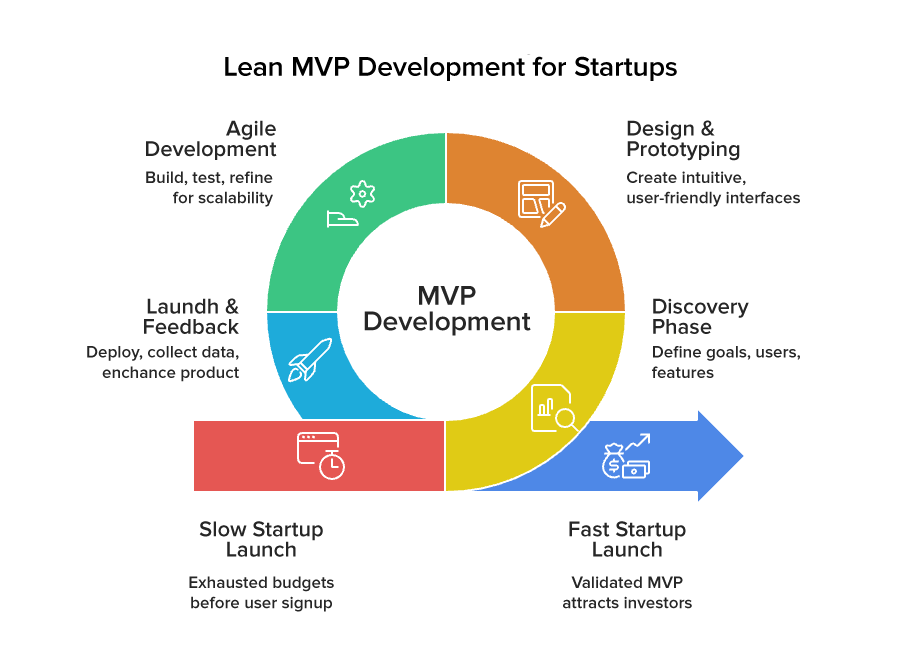
For many Southeast Asia startups, the biggest challenge isn’t generating ideas, it’s executing them before funding runs out or competitors catch up. Spending a year developing a product that users might not want is a luxury few founders can afford.
The MVP development process focuses on what truly matters: understanding your users, validating your solution, and refining it continuously. It starts with clarifying your idea’s core value and identifying the real problem it solves. From there, you create simple prototypes to visualise the user journey, gather early reactions, and spot friction points.
Agile development then turns these insights into action, building and testing your MVP in short sprints. Launching early allows you to collect genuine user feedback, learn what works, and adapt before scaling. Startups that follow this process find product-market fit faster, attract investors sooner, and grow with confidence in Southeast Asia’s competitive environment.
Scale Smart Across Southeast Asia
If you’re a Southeast Asia startup with a big idea, now is the time to bring it to life. An MVP lets you test early, learn fast, and scale sustainably, all while reducing risk and cost. At eFusion Technology, we combine strategy, design, and agile development to help founders across the region launch confidently and grow efficiently. Our team of developers, designers, and strategists works closely with startups to transform ideas into investor-ready products that perform. Contact us today to discuss your MVP development project and turn your startup vision into a working product. Because in Southeast Asia’s fast-moving startup scene, the smartest products don’t start big; they start right.