

Have you forgotten why your website still matters?
In recent years, LinkedIn has become one of the primary channels for B2B visibility. More businesses are actively sharing insights, building personal brands, and driving traffic through consistent content.
This shift has created new opportunities for reaching potential customers. However, it has also exposed a common gap.
While many companies are effective at generating attention, fewer are prepared for what happens after a visitor clicks through to their website. In many cases, the website experience does not match the quality of the content that brought the visitor there.
This disconnect can significantly impact conversion outcomes.
Key Takeaways
- LinkedIn is effective for generating traffic, but not for closing decisions
- Your website plays a central role in building trust and clarity
- Poor website structure can reduce both user engagement and search visibility
- Conversion issues are often caused by unclear messaging, not lack of traffic
- Improving your website can unlock value from existing marketing efforts
What role does your website play in the buyer journey?
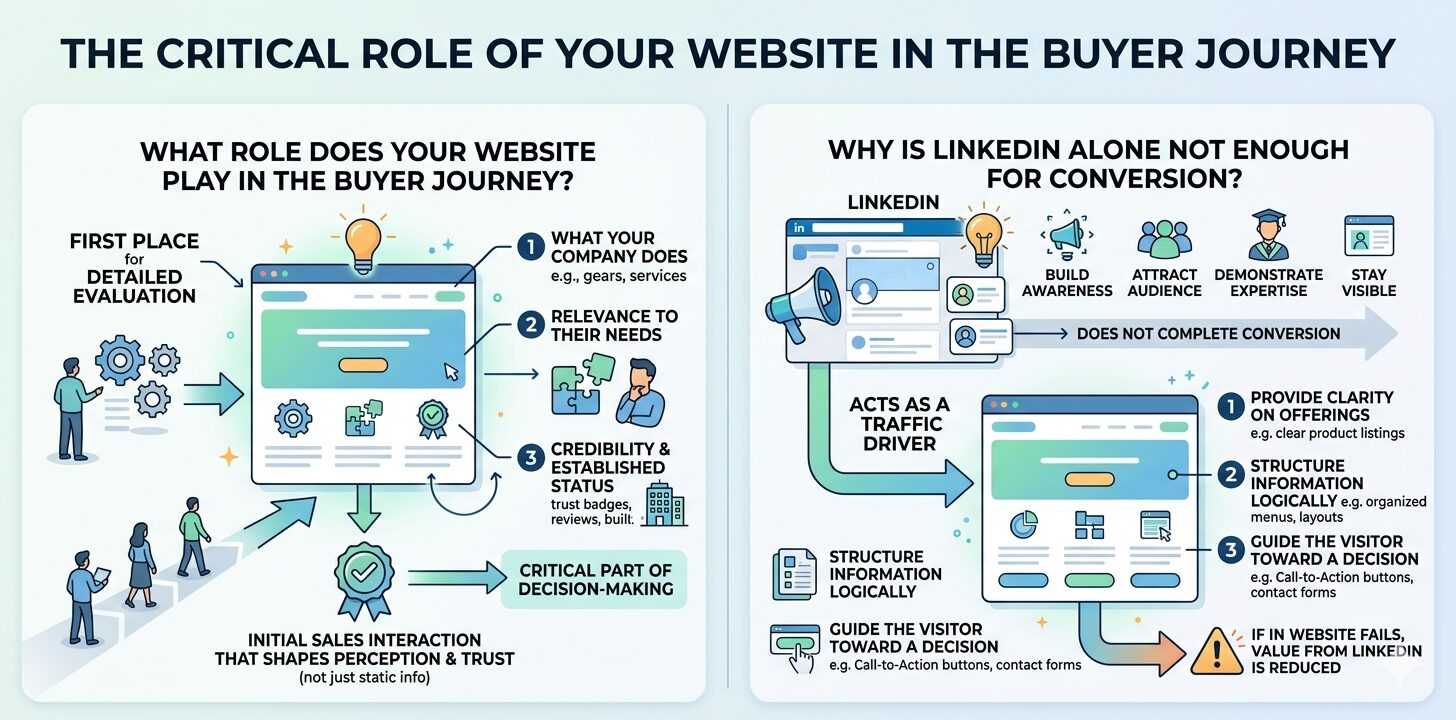
A website is often the first place where a potential customer evaluates your business in detail.
Before initiating contact, visitors typically use your website to assess:
- What your company actually does
- Whether your services are relevant to their needs
- How credible and established your business appears
This makes your website a critical part of the decision-making process. Rather than acting as a static information source, it functions as an initial sales interaction that shapes perception and trust.
Why is LinkedIn alone not enough for conversion?
LinkedIn is highly effective for building awareness and attracting the right audience. It allows businesses to communicate ideas, demonstrate expertise, and stay visible within their industry.
However, LinkedIn does not complete the conversion process. Instead, it acts as a traffic driver.
Once a visitor clicks through, your website becomes responsible for:
- Providing clarity on your offerings
- Structuring information in a logical way
- Guiding the visitor toward a decision
If the website does not support this process, the value generated from LinkedIn activity is reduced.
What happens when your website lacks clarity?
When visitors land on a website and cannot quickly understand its purpose, several issues arise.
They may:
- Leave without taking further action
- Misinterpret your positioning
- Compare your services primarily on price
- Choose competitors with clearer messaging
These outcomes are rarely caused by lack of traffic, they are typically caused by lack of clarity.
From a technical perspective, unclear structure also affects how search engines and AI systems interpret your content.
As highlighted in modern SEO practices, structure helps translate your content into a format that machines can understand. Without clear hierarchy and organization, even strong content may not perform effectively.
Why is this a destination problem rather than a marketing problem?
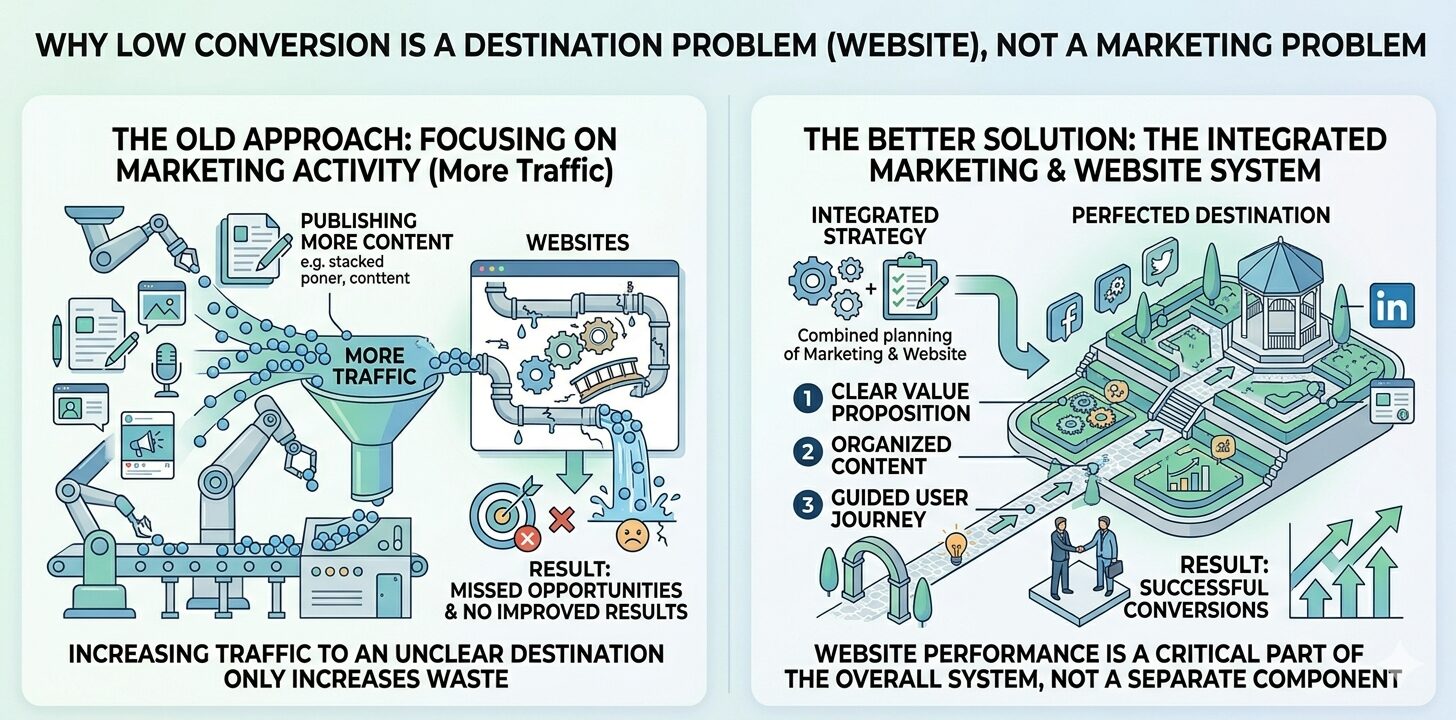
When conversion rates are low, many organizations focus on increasing activity:
- Publishing more content
- Running additional campaigns
- Driving more traffic
While these efforts can improve visibility, they do not address the underlying issue if the website experience remains unchanged. If the destination is unclear, increasing traffic will not improve results. Instead, it increases the number of missed opportunities.
This is why website performance should be evaluated as part of the overall marketing system, not as a separate component.
How can you assess whether your website is underperforming?
There are several indicators that a website may not be supporting conversion effectively:
- Visitors do not take action after landing on key pages
- Sales conversations begin with basic clarification questions
- Your positioning feels unclear or inconsistent
- Prospects focus primarily on pricing rather than value
These signals suggest that the website may not be providing sufficient clarity or guidance.
What makes a website effective in today’s digital landscape?
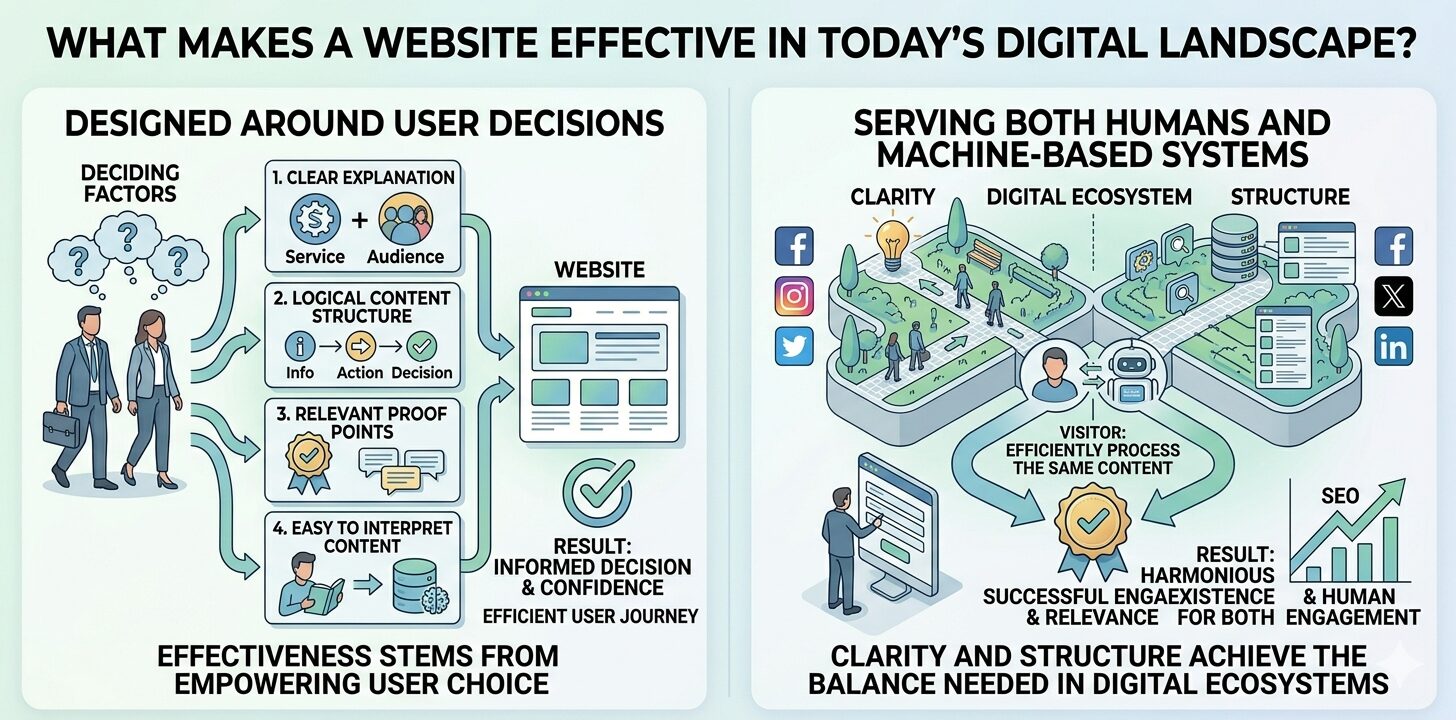
An effective website is designed around how users make decisions.
- Clear explanation of services and target audience
- Logical content structure that guides users step by step
- Relevant examples or proof points to support credibility
- Content that is easy for both users and search systems to interpret
As digital ecosystems evolve, websites must serve both human visitors and machine-based systems. Clarity and structure play a key role in achieving this balance.
How eFusion Technology helps you turn your website into a conversion asset
At eFusion Technology, we approach this as a structural challenge rather than a surface-level issue.
Instead of focusing on isolated improvements, we help businesses:
- Fix gaps in messaging so visitors can quickly understand your value
- Redesign website structure to align with how buyers evaluate options
- Strengthen trust signals across key pages
- Build SEO and AI-ready foundations that improve content understanding
- Align website experience with LinkedIn and other marketing channels
The objective is not only to increase traffic, but to ensure that incoming visitors are more likely to convert into meaningful opportunities.
Conclusion
LinkedIn has become a powerful channel for attracting attention and generating interest. However, attention alone does not lead to business outcomes.
Your website is where that interest is evaluated, validated, and converted. Organizations that align their website experience with their marketing efforts are better positioned to turn visibility into measurable results.
If your business is actively generating traffic but not seeing corresponding results, your website may be the limiting factor.
At eFusion Technology, we help organizations improve website clarity, structure, and conversion performance through a structured digital approach. If you are reviewing your website strategy, contact us to start with a discussion to identify areas for improvement.
FAQ
Why isn’t my website converting LinkedIn traffic?
Because the website may not clearly communicate your value or guide visitors toward action.
What should I improve first on my website?
Start with messaging clarity and content structure before focusing on design changes.
Does SEO still matter for websites?
Yes. SEO ensures your content can be properly understood and discovered by search engines and AI systems.