

Many e-commerce businesses slow down not because demand drops, but because their systems can no longer keep up, platforms that once enabled fast launch start limiting change, integration, and expansion. Simple updates affect checkout stability, and adding new channels becomes complex.
What worked early on was rarely designed for scale. At this stage, e-commerce architecture becomes a business resilience decision. Understanding when headless and API-first approaches make sense helps business owners support growth without unnecessary complexity.
Key Takeaways
- What worked for early-stage e-commerce often limits scale and integration later.
- Headless and API-first architecture are business decisions, not technology trends.
- Modern architecture improves flexibility, scalability, and integration readiness.
- Not every business needs headless commerce, timing matters.
- Architecture choices directly affect UX, checkout performance, and conversion.
Why What Used to Work Now Limits E-Commerce Growth
Many e-commerce businesses reach a stage where growth creates friction instead of momentum. Integrations become harder to manage, frontend changes take longer than expected, and simple updates start affecting checkout stability or reporting accuracy. What once felt efficient begins to feel restrictive.
These issues are rarely caused by marketing or product quality. They are usually symptoms of an underlying structural problem. The platform was chosen for speed of launch, not long-term scale. As omnichannel expectations rise and systems multiply, architecture becomes a question of business resilience rather than technical preference.
Understanding modern e-commerce architecture helps business owners evaluate whether their current setup supports growth or quietly holds it back.
What Modern E-Commerce Architecture Means in Business Terms
Modern e-commerce architecture refers to structuring systems, so customer experience, operations, and integrations can evolve independently.
A simple analogy helps. Traditional platforms are like a shop where the storefront, storeroom, and cashier are permanently locked together with any change to one area affects the rest. Meanwhile, modern architecture allows you to renovate the storefront without closing the store or disrupting backend operations.
This flexibility comes from separation, not added complexity.
What Do “Headless” and “API-First” Actually Mean?
What Is Headless Commerce?
In headless commerce architecture, the customer-facing frontend is separated from the backend commerce engine. This allows businesses to redesign user experiences, launch new interfaces, or localise content without changing how products, orders, or payments are handled.
From a business perspective, Shopify also explains how headless commerce enables brands to evolve customer experiences without rebuilding core systems.
Example: You refresh your website UX or introduce a new mobile experience without touching checkout logic or inventory workflows.
What Does API-First Mean?
An API-first development model prioritises system communication from the start. Instead of adding integrations later, APIs are designed upfront so systems connect cleanly as the business grows.
This approach supports flexibility and reduces integration friction. Many organisations adopt API-first benefits for scalable systems to extend digital capabilities without re-architecting their entire platform.
Example: Your e-commerce platform integrates smoothly with accounting, CRM, logistics, or marketing tools without fragile workarounds.
Where Microservices Fit In
Modern approaches such as MACH architecture principles combine microservices, API-first design, cloud-native infrastructure, and headless frontends. For businesses, this means lower risk when upgrading or scaling specific components instead of rebuilding everything at once.
When Does Headless and API-First Architecture Make Sense?
You are likely ready for modern architecture if:
- You sell across multiple channels or touchpoints
- Integrations with ERP, CRM, POS, or logistics are business-critical
- UX updates need to happen without disrupting operations
- Performance and scalability directly affect revenue
- Regional expansion or localisation is planned
In these scenarios, architecture supports growth instead of reacting to it.
When Headless Commerce Does NOT Make Sense
Avoid moving too early if:
- Your product catalogue and checkout flow are straightforward
- Speed to market is a higher priority than flexibility
- Internal resources to manage multiple systems are limited
- You are still validating product-market fit
Complex architecture too early increases cost and maintenance effort without delivering immediate value.
Common Architecture Pitfalls Business Owners Should Avoid
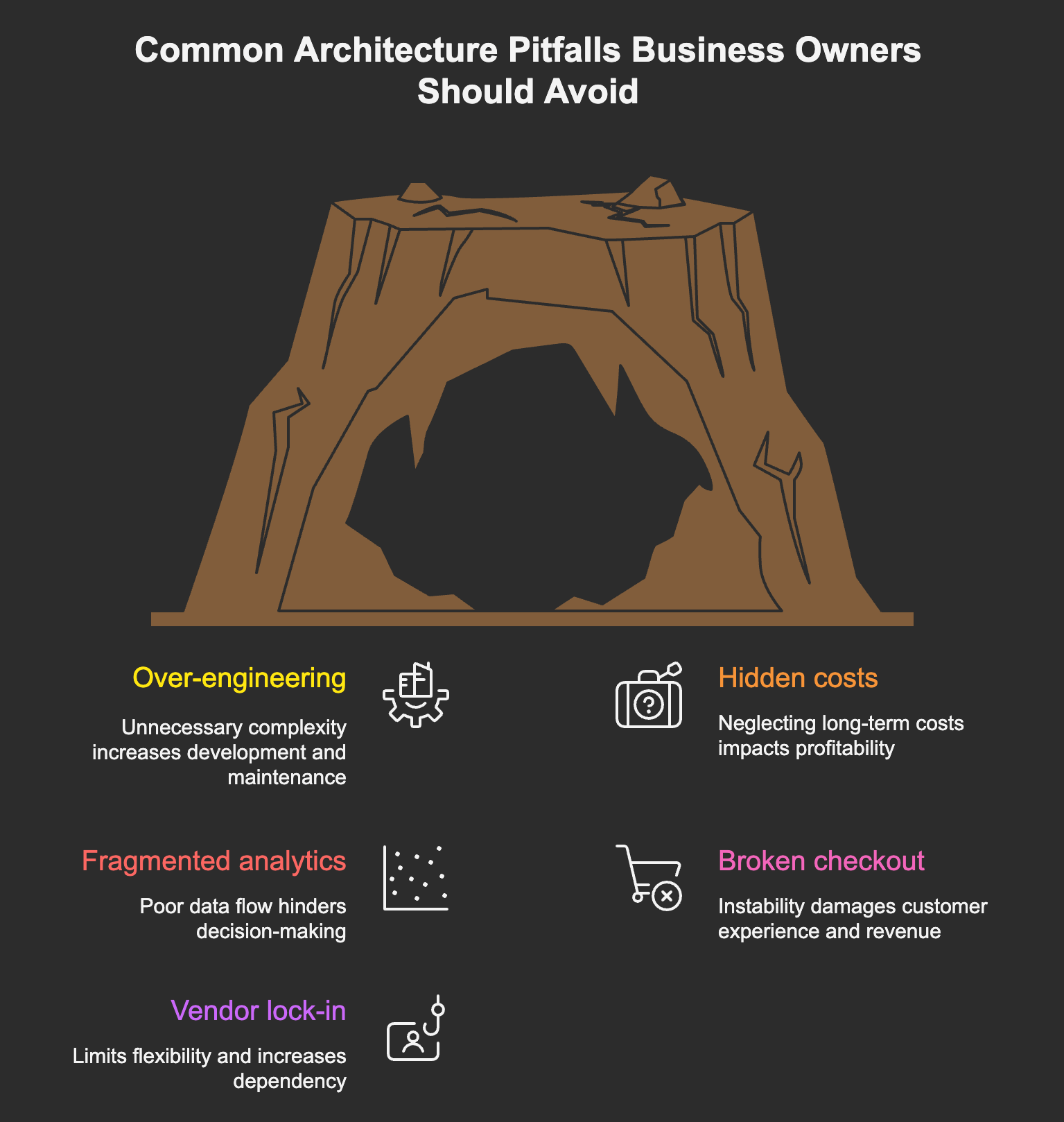
- Over-engineering too early Fix: Start with business requirements, not trends.
- Hidden maintenance costs Fix: Consider long-term ownership, not just building costs.
- Fragmented analytics and reporting Fix: Plan data flows and report architecture upfront.
- Broken checkout or inconsistent UX Fix: Protect checkout stability while improving front-end experiences.
- Vendor lock-in risk Fix: Ensure data portability and integration flexibility from day one.
How Architecture Impacts Conversion and UX Outcomes
Architecture has a direct impact on conversion performance. Well-planned systems support:
- Intuitive navigation that improves product discovery
- Clear information structure across pages and channels
- Trust reinforcement through consistent UI and performance
- Friction-free checkout that remains stable as traffic grows
- Consistent cross-device experiences
When operational workflows such as content updates, customer support, merchandising, and analytics are streamlined or AI-assisted, teams spend less time on repetitive tasks and more time improving UX and conversion optimisation.
At eFusion Technology, these outcomes are supported through e-commerce services designed around real operational needs rather than rigid platform limitations.
Implementation Options: A Business-First Approach
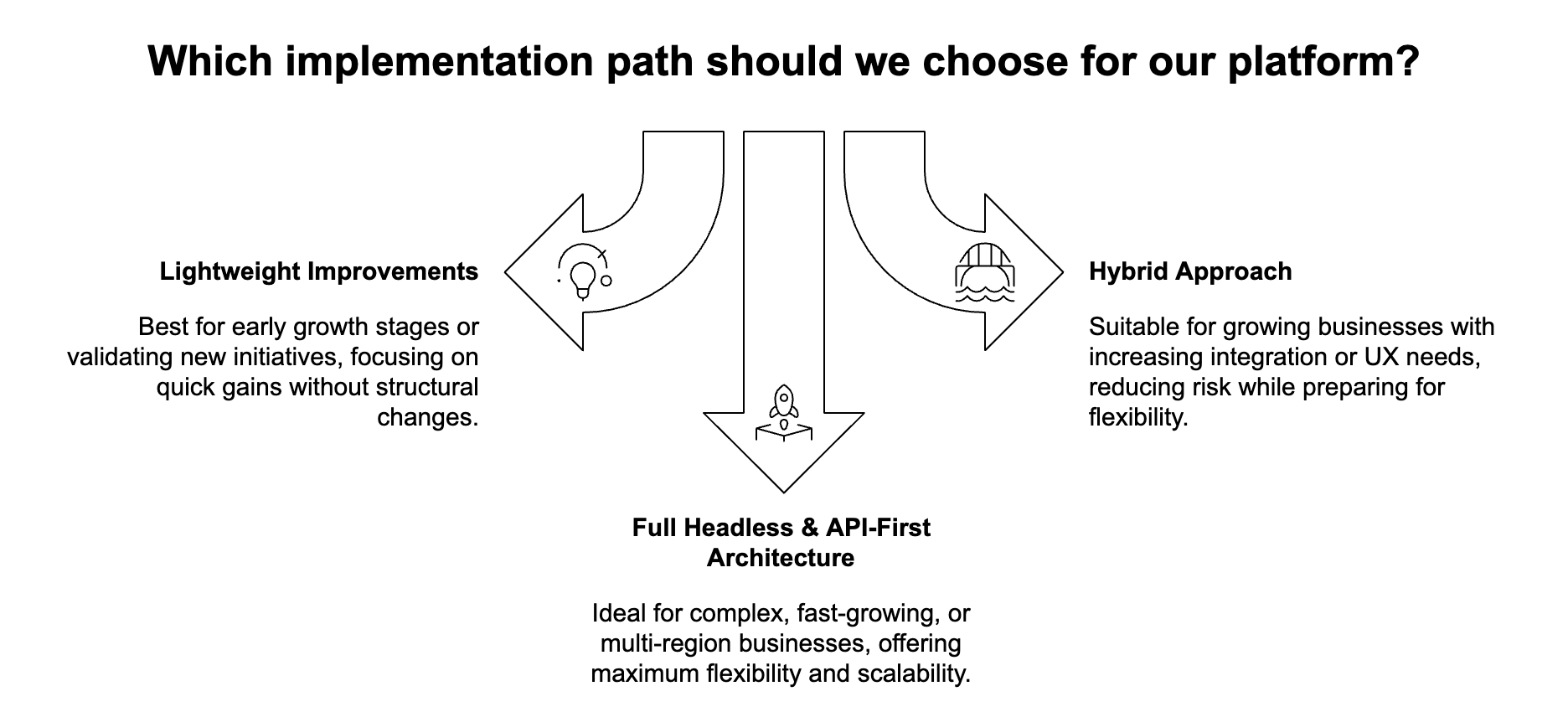
Most businesses follow one of these paths:
1) Lightweight Improvements
Optimise UX, performance, and integrations within the existing platform. This approach prioritises quick gains without structural changes and suits businesses that need immediate optimisation while maintaining stability.
Best for: early growth stages or businesses validating new initiatives.
2) Hybrid Approach
Gradually decouple frontend or key integrations while reducing risk. This reduces risk while preparing the platform for greater flexibility over time.
Best for: growing businesses with increasing integration or UX requirements.
3) Full Headless and API-First Architecture
Redesign the platform with separation between frontend and backend, supported by API-driven integrations. This approach offers the highest level of flexibility and scalability but requires careful planning and strong operational alignment.
Best for: complex, fast-growing, or multi-region businesses.
Each option represents a different level of effort, coordination, and change management. Choosing the right path is about aligning technology decisions with business maturity, internal capabilities, and long-term growth plans rather than pursuing complexity for its own sake.
Planning E-Commerce Architecture for Long-Term Growth
Modern e-commerce architecture is not about adopting trends. It is about ensuring your digital platform does not limit growth, conversion, or operational clarity as the business scales.
For Singapore SMEs navigating omnichannel realities and regional marketplaces, early architecture decisions reduce long-term cost and complexity. The goal is to build adaptable systems that evolve with the business.
For organisations requiring deeper integrations or custom workflows, web application solutions provide scalable back-end systems aligned with real business processes. Combined with advisory-led planning, this creates a foundation for sustainable digital growth.
Talk to eFusion Technology to assess whether your e-commerce architecture is built for where your business is going next.